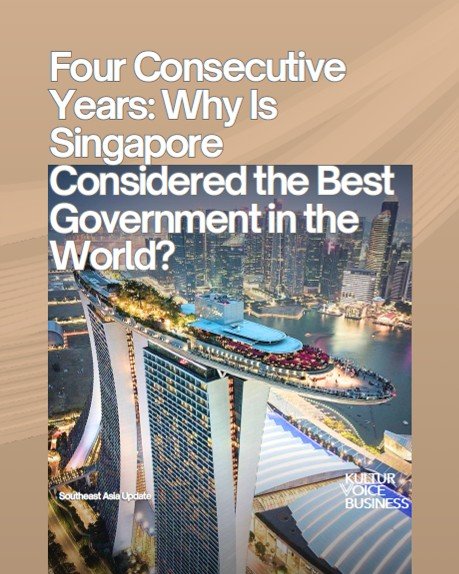

For fourth consecutive year Singapore government has retained the reputation of effective governance as it is on the first place of Chandler Good Government Index (CGGI) 2016. The index assesses government capability across 35 indicators grouped into seven pillars, focusing on how well countries create the conditions for economic and social progress.
What makes Singapore government effective? In 2026, Singapore led the world in five pillars: Leadership & Foresight, Strong Institutions, Financial Stewardship, Attractive Marketplace, and Helping People Rise.
Leadership and foresight
Singapore’s success begins with its ability to anticipate challenges and plan beyond the immediate future. Rather than waiting for problems to emerge, the government prepares for risks decades in advance. The Singapore Green Plan 2030 sets measurable sustainability targets while advancing the longer-term goal of net-zero emissions by 2050. It also addresses pressures specific to a small island nation, including sea-level rise and climate resilience. This approach combines long-range planning with the flexibility to respond to evolving environmental and economic conditions.
Strong institutions
Strong institutions form another foundation of Singapore’s governance performance. The Corrupt Practices Investigation Bureau (CPIB), an independent anti-corruption agency supported by the Prevention of Corruption Act, can investigate corruption and pursue offenders regardless of status or position. This capacity matters because effective governance depends not only on sound policies, but also on consistent enforcement and accountability. Singapore’s institutional framework therefore helps provide a stable, predictable environment for citizens and businesses.
Financial stewardship
Singapore’s approach to financial stewardship balances current needs with the interests of future generations. Under the Net Investment Returns Contribution (NIRC) framework, the government may use a portion of the expected long-term returns on national reserves to fund public services while preserving the underlying assets. These returns finance about 20% of annual government spending, supporting education, healthcare, transport infrastructure, and research and development. Constitutional safeguards—including the President’s role in the “Two-Key” system—also help protect Past Reserves from imprudent use. Together, these measures demonstrate a disciplined balance among investment, public spending, and long-term preservation.
Attractive Marketplace
Effective governance also strengthens Singapore’s appeal as a marketplace. For a small, highly open economy, institutional stability, prudent financial management, and a predictable business environment inspire confidence among companies and investors. Governance is therefore more than an administrative function: it is an economic asset that supports investment, innovation, and long-term competitiveness.
Helping people rise
This pillar emphasizes the human purpose of governance: national progress matters only when economic growth creates opportunities for people to improve their lives. Singapore directs national resources toward education, healthcare, infrastructure, and social development. By linking economic strength with investment in people, the country shows how effective governance can expand opportunity while sustaining prosperity.
Singapore’s four-year run at the top of the CGGI represents more than a series of strong rankings. It shows how long-term vision, capable institutions, financial discipline, economic competitiveness, and investment in people can reinforce one another. The country’s sustained performance offers a compelling example of governance as a foundation for national resilience, sustainable growth, and shared progress.
Explore Southeast Asia’s opportunities. Read the latest stories on business, entrepreneurship, culture, and leadership across one of the world’s most dynamic regions.
Latest news from Kultur Voice Business