
A family business is built on the idea of staying: staying through difficult years, staying committed to the name, and staying close to what generations before you created.
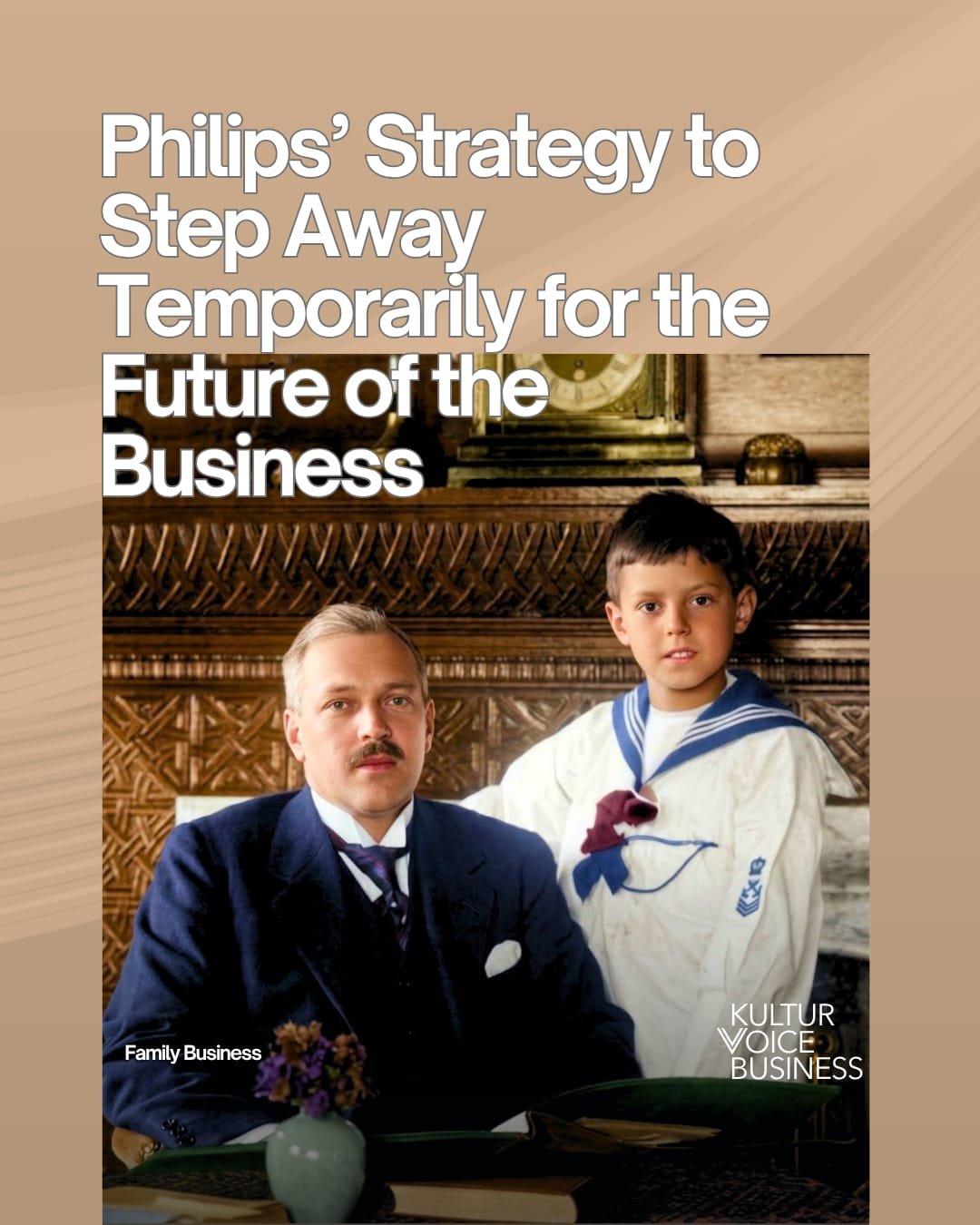
But what happens when staying is no longer the safest choice? The story of Philips offers an extraordinary answer. When Nazi Germany invaded the Netherlands in 1940, the Philips family faced a decision few business owners could ever imagine. Anton Philips and several members of the family fled to the United States, leaving behind their home and the company their family had spent decades building.
Leaving was not an easy surrender of the business. It was a strategic decision shaped by extraordinary circumstances; one that prioritized survival, safety, and the possibility of a future beyond the war. Back in Eindhoven, Frits Philips remained and took responsibility for the company under Nazi occupation. He worked to protect Philips employees, while navigating an increasingly dangerous environment. He was eventually arrested and later forced into hiding.
Different members of the same family therefore found themselves taking different paths, some leaving, others staying, but with a shared purpose: protecting people and preserving what could still be preserved. After the liberation of Eindhoven in 1944, the Philips family reunited. The company survived the war and continued its evolution, eventually growing from its origins in light bulbs into a global health technology business.
For family businesses, the story carries a lesson that extends beyond wartime. Legacy is not always about holding on. Sometimes, protecting the future requires the courage to step away from what you have built. It may mean leaving a market, cutting ties, changing ownership, or temporarily walking away from control. The instinct to stay can be powerful. But knowing when leaving serves the greater good can be just as important.
Koninklijke Philips N.V., commonly known as Philips, is a Dutch multinational health technology company and former major consumer electronics manufacturer. The company was founded in Eindhoven in 1891 by Gerard Philips and his father Frederik Philips to manufacture incandescent light bulbs. In October 1997, Philips decided to move its corporate headquarters from Eindhoven to Amsterdam, with the relocation beginning the following year. The company’s headquarters remain in Amsterdam. Philips was awarded the Dutch Royal designation by Queen Wilhelmina in 1916; Koninklijke became part of the company name in 1998.
Through the 20th century, Philips developed into a large electronics conglomerate, producing products ranging from kitchen appliances and electric shavers to lighting equipment and televisions. Philips introduced the compact cassette format, which became a widely adopted standard for tape recording. The company later collaborated with Sony in developing the compact disc standard. Philips also became a major participant in the entertainment industry through its controlling interest in PolyGram, which it sold to Seagram in 1998.
From the 2010s, Philips progressively shifted its focus toward health technology. Its television business was transferred to the TP Vision joint venture in 2012. Its lighting business was separated from Philips in 2016 and renamed Signify in 2018. Philips completed the sale of its Domestic Appliances business in 2021; the independent company was renamed Versuni in 2023.
As of 2025, Philips reports three main business segments: Diagnosis & Treatment, Connected Care and Personal Health. Philips is listed on Euronext Amsterdam under the symbol PHIA and on the New York Stock Exchange under the symbol PHG. It is also a component of the Euro Stoxx 50 index. Historical acquisitions included Signetics in 1975 and Magnavox in 1974. The Philips Sports Association, which includes the football club PSV Eindhoven, was founded in 1913 for Philips employees.
Explore contents on family business, culture, lifestyle, Southeast Asia also Brand Boardroom by KVB Global Agency and the Future of Work by gighub.id.
Latest news from Kultur Voice Business