
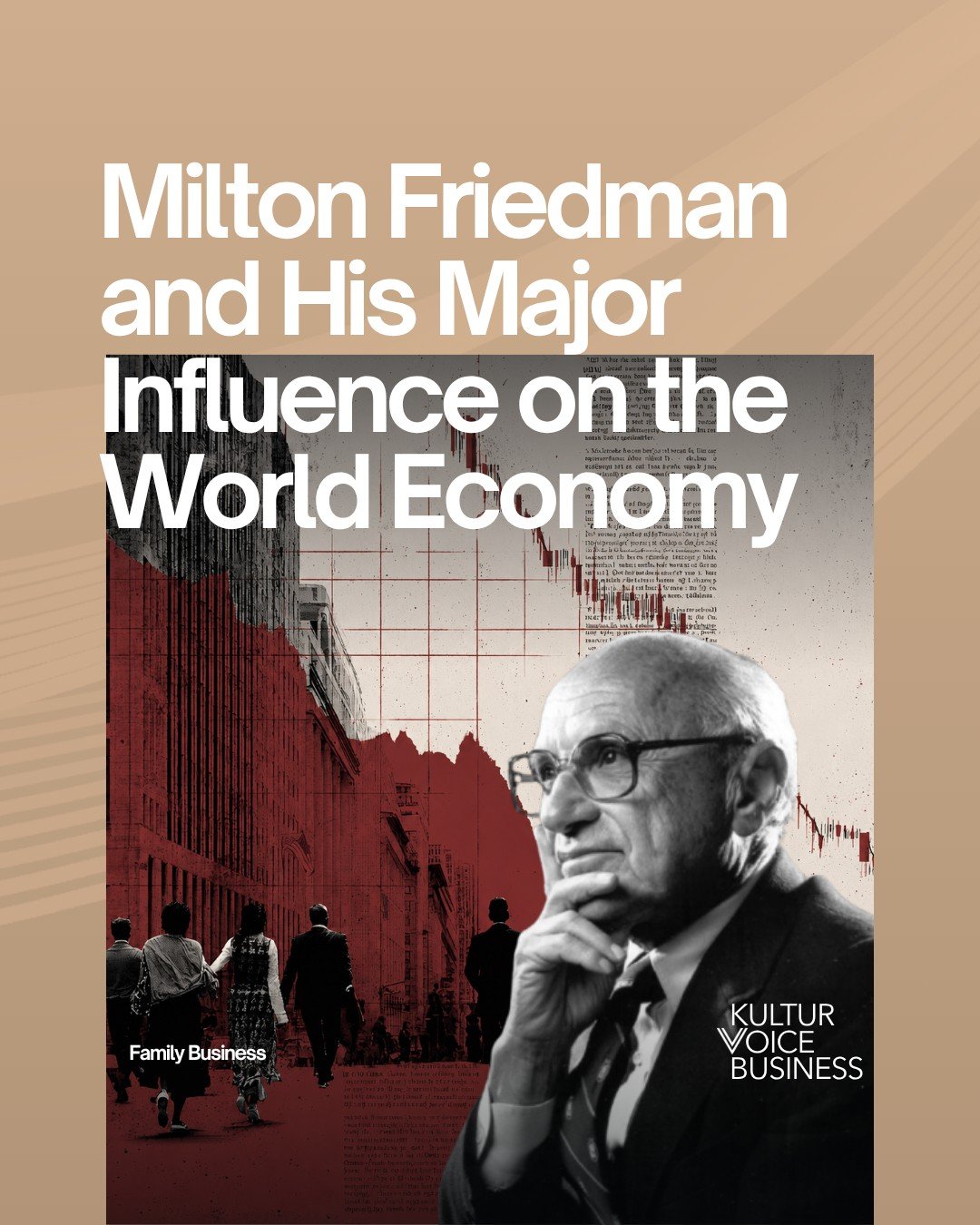

Despite pros and cons surrounding it, Milton Friedman’s ideas remain one of the key foundations shaping global economic policies to this day.
Milton Friedman was one of the most influential economists of the twentieth century, with The Economist magazine described him as “the most influential economist of the second half of the 20th century … possibly of all of it” and received the 1976 Nobel Memorial Prize in Economic Sciences for his research on consumption analysis, monetary history and theory and the complexity of stabilization policy. His ideas shaped modern economic policy and sparked debates that continue today.
After getting his PhD from Columbia in 1946, Friedman taught at the University of Chicago. With George Stigler, Friedman was among the intellectual leaders of the Chicago school of economics, a neoclassical school of economic thought associated with the faculty at the University of Chicago.
As a leading figure of the Chicago School of Economics, Friedman believed strongly in free markets, limited government intervention, and individual economic freedom. His theories challenged the traditional Keynesian approach, which emphasized heavy government spending to manage the economy. During the 1960s, he became the main advocate opposing both Marxist and Keynesian government and economic policies and described his approach (along with mainstream economics) as using “Keynesian language and apparatus” yet rejecting its initial conclusions.
Friedman criticized excessive government involvement in the economy. He believed that free markets are generally more efficient than government-controlled systems because individuals and businesses respond better to incentives and competition. In his famous book published in 1962, Capitalism and Freedom, he argued that economic freedom is closely connected to political freedom. He believed that when people are free to make economic choices, societies become more innovative and prosperous.
Friedman’s challenges to what he called “naive Keynesian theory” began with his interpretation of consumption, which tracks how consumers spend. He introduced the permanent income hypothesis, a theory which would later become part of mainstream economic, and he was among the first to propagate the theory of consumption smoothing. This theory suggests that people base their spending decisions not only on their current income but also on their expectations for future income. As a result, temporary changes in income may not significantly affect consumer spending. This idea influenced later research in economics and finance.
One of Friedman’s most important contributions was his theory of monetarism. He argued that the amount of money circulating in an economy is the main factor affecting inflation and economic stability. According to Friedman, when governments increase the money supply too quickly, inflation rises. On the other hand, if the money supply grows too slowly, economic growth can weaken and unemployment may increase. Because of this, Friedman believed central banks should maintain a steady and predictable growth of the money supply rather than making sudden policy changes.
Friedman’s theories had a major impact on governments around the world, especially during the 1980s. After retiring from the University of Chicago in 1977, and becoming emeritus professor in economics in 1983, Friedman served as an advisor to former US President Ronald Reagan and British Prime Minister Margareth Thatcher. Both leaders adopted policies inspired by his support for deregulation, lower taxes, and free-market capitalism. Although some critics argue that his ideas can increase inequality and reduce social welfare, supporters believe his theories encourage efficiency, innovation, and long-term economic growth.
Overall, Milton Friedman’s economic theory emphasized the power of free markets and careful control of the money supply. His ideas continue to influence economic thinking and policymaking across the world today. His monetary theory influenced the Federal Reserve’s monetary policy in response to the 2008 financial crisis.
Global shifts don’t wait—and those who understand them early gain the advantage. If you want sharper perspective on trade, geopolitics, and regional dynamics, explore more on KVB.global. Share this insight with your team and follow Kultur Voice Business or KVB to stay strategically informed.
Latest news from Kultur Voice Business
zimerovertover 10 Aug 2026
I went over this website and I believe you have a lot of good information, saved to my bookmarks (:.