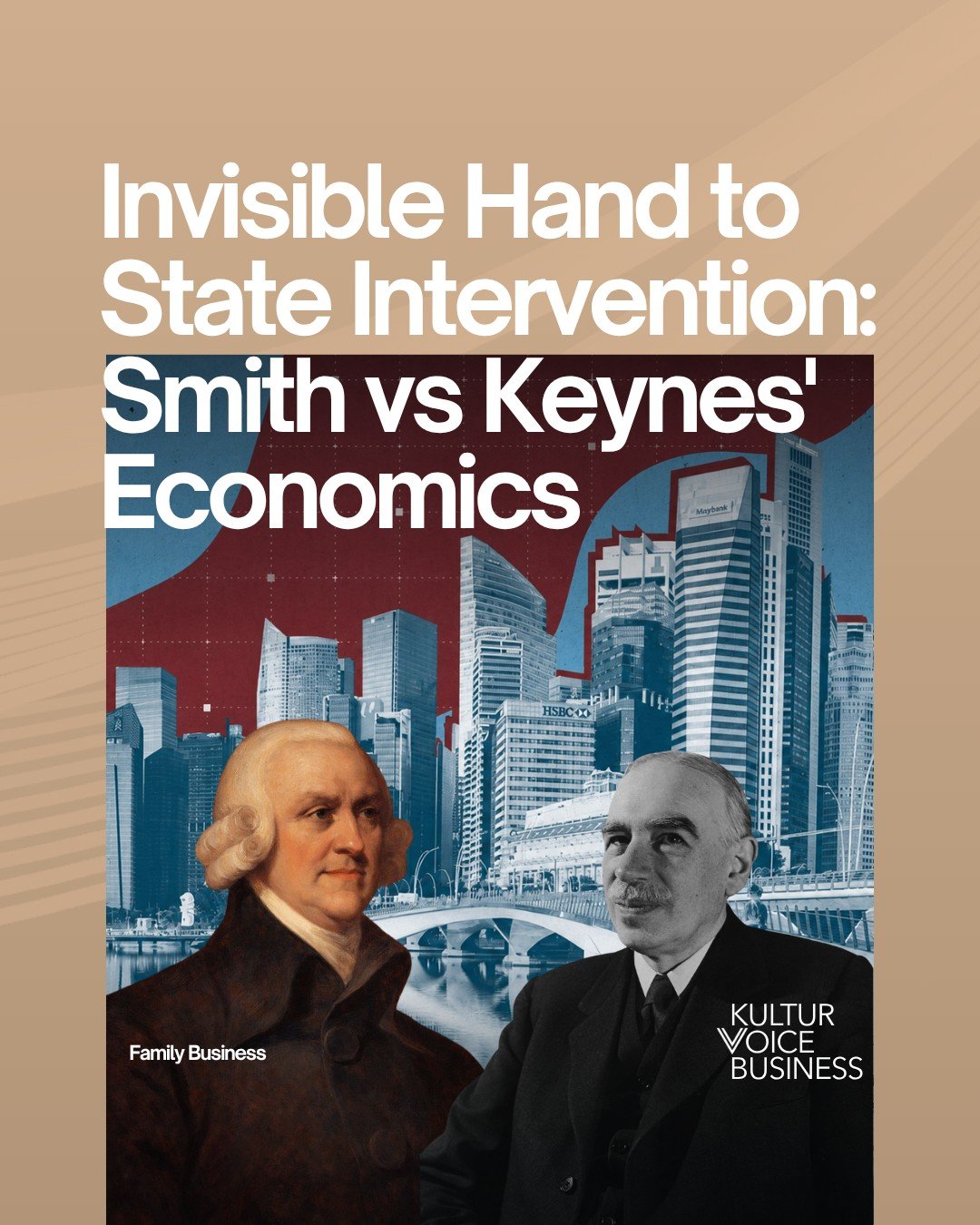

Looking at global economy and how the world is changing, it is useful to learn again about the economy theories by the most influential figures John Maynard Keynes and Adam Smith.
Both thinkers sought to explain how societies create prosperity and maintain economic stability and although both made significant contributions to economics, their views on the role of government and market mechanisms differ fundamentally.
Adam Smith, often regarded as the father of modern economics, believed that individuals pursuing their own self-interest would ultimately benefit society. Through his famous concept of the “invisible hand,” Smith argued that free markets can regulate themselves through competition, supply, and demand. According to him, excessive government intervention could hinder efficiency and innovation. Therefore, Smith supported a limited role for government, mainly focused on maintaining law, security, and public infrastructure. His ideas later became the foundation of classical economics and modern capitalism.
In contrast to Adam Smith, John Maynard Keynes developed his theories during the Great Depression of the 1930s, when many countries faced severe economic crises and massive unemployment. Keynes rejected the belief that markets could always correct themselves. He argued that during times of crisis, consumer demand could fall drastically, causing businesses to reduce production and workers to lose their jobs. This situation created a cycle of economic decline that would be difficult to stop without government assistance. For this reason, Keynes emphasized the importance of government intervention through public spending, lower interest rates, and other economic policies aimed at increasing demand and restoring the economy.
The comparison between Smith’s and Keynes’s ideas highlights two different perspectives on economic balance. Smith placed greater trust in the natural ability of free markets to create prosperity, while Keynes believed that markets sometimes fail and therefore require active government involvement. Despite their differences, both thinkers shared the same goal: achieving public welfare and stable economic growth.
The ideas of Adam Smith and John Maynard Keynes continue to influence modern economic policy. Free-market systems inspired by Smith remain the foundation of the global economy, while Keynesian policies are often applied during economic crises to support recovery. Their differing perspectives demonstrate that economics is a constantly evolving field shaped by social conditions and the challenges of each era.
Adam Smith was a Scottish economist and philosopher born in 1723 who is widely regarded as the father of modern economics. He is best known for his influential book The Wealth of Nations (1776), in which he introduced the concept of the “invisible hand.” Smith believed that individuals pursuing their own self-interest in a free market could unintentionally promote economic prosperity for society. His ideas emphasized limited government intervention, free trade, and competition, which later became the foundation of classical economics and modern capitalism. Beyond economics, Smith also contributed to moral philosophy through his earlier work, The Theory of Moral Sentiments.
John Maynard Keynes was a British economist born in 1883 who became one of the most influential economic thinkers of the twentieth century. He gained global recognition through his response to the Great Depression, arguing that free markets could not always stabilize themselves during economic crises. In his landmark book The General Theory of Employment, Interest and Money (1936), Keynes proposed that governments should actively intervene in the economy through public spending and monetary policies to stimulate demand and reduce unemployment. His ideas formed the basis of Keynesian economics and strongly influenced modern economic policy, especially during periods of recession and financial instability.
What do you think of global economic today?
Global shifts don’t wait—and those who understand them early gain the advantage. If you want sharper perspective on trade, geopolitics, and regional dynamics, explore more on KVB.global. Share this insight with your team and follow Kultur Voice Business or KVB to stay strategically informed.
Latest news from Kultur Voice Business