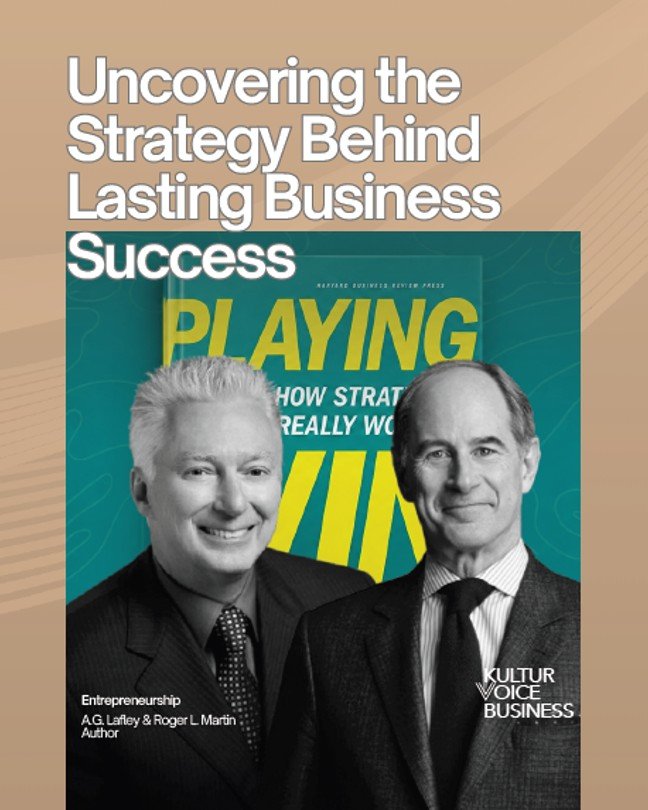

Successful businesses focus on making disciplined decisions about where they can truly win, rather than attempting to participate in every opportunity. A true strategy is an integrated set of deliberate choices that positions an organization to achieve a sustainable competitive advantage.
According to Playing to Win: How Strategy Really Works by A.G. Lafley and Roger L. Martin, these elements alone do not constitute a strategy, while many organizations believe they have a strategy simply because they have ambitious goals, detailed plans, or long-term visions.
At the heart of the book is the Strategic Choice Cascade, a framework consisting of five interconnected questions: What is our winning aspiration? Where will we play? How will we win? What capabilities must we build? And what management systems are required to support those capabilities? These questions are not meant to be answered independently. Instead, each decision influences the next, creating a coherent strategy that aligns an organization’s purpose, operations, and execution.
Among these five choices, the authors emphasize that where to play and how to win form the core of competitive strategy. Choosing where to play means identifying the markets, customer segments, products, channels, or regions where a company can create the greatest value. Meanwhile, deciding how to win requires defining a unique competitive advantage, whether through cost leadership or meaningful differentiation. Without clarity on these two dimensions, businesses risk spreading their resources too thin and losing focus.
However, a compelling strategy is only as strong as the organization’s ability to execute it. The book highlights that companies must develop capabilities specifically aligned with their strategic choices, rather than pursuing excellence in every area. Equally important are the management systems that reinforce those capabilities through performance measurement, incentives, and continuous feedback. In other words, execution is embedded within strategy.
One of the book’s most valuable lessons is that strategy demands trade-offs. Every strategic “yes” inevitably requires saying “no” to other attractive opportunities. Organizations that attempt to satisfy every customer, enter every market, or pursue every trend often end up with no distinctive position at all. Winning companies recognize that focus is a competitive advantage, not a limitation.
Playing to Win reframes strategy as a series of intentional choices rather than an abstract planning exercise. Success is not determined by the number of opportunities an organization pursues, but by its willingness to commit to the right ones. By defining a clear aspiration, choosing where to compete, building the capabilities to excel, and maintaining systems that reinforce execution, businesses can move beyond simply staying in the game and they can position themselves to win.
Alan George “A.G.” Lafley is an American business executive and former chairman, president, and CEO of American consumer multinational goods company Procter & Gamble. He led P&G in two stints (2000–2010, 2013–2015), revitalizing the company under the mantra “Consumer is Boss” and focusing on billion-dollar brands like Tide, Pampers, and Crest while introducing innovations such as Swiffer and Febreze. A U.S. Navy veteran with an MBA from Harvard, Lafley doubled P&G’s sales during his first tenure, expanded its brand portfolio, and was named CEO of the Year in 2006.
Roger L. Martin is a Canadian business strategist, author, and Professor Emeritus at the Rotman School of Management, University of Toronto. Recognized as the world’s #1 management thinker by Thinkers50 in 2017 and #1 management consultant in 2026, he served as Rotman’s dean from 1998 to 2013 and advised CEOs at companies like Procter & Gamble, Lego, and Ford. A pioneer of integrative and design thinking, he has written 13 books, including Playing to Win, Getting Beyond Better, When More is Not Better, and A New Way to Think, and over 30 Harvard Business Review articles.
Join the conversation on family business, voice, and culture. Subscribe to Kultur Voice Business for stories, insights, and perspectives from founders, owners, and next-generation leaders.
Latest news from Kultur Voice Business