
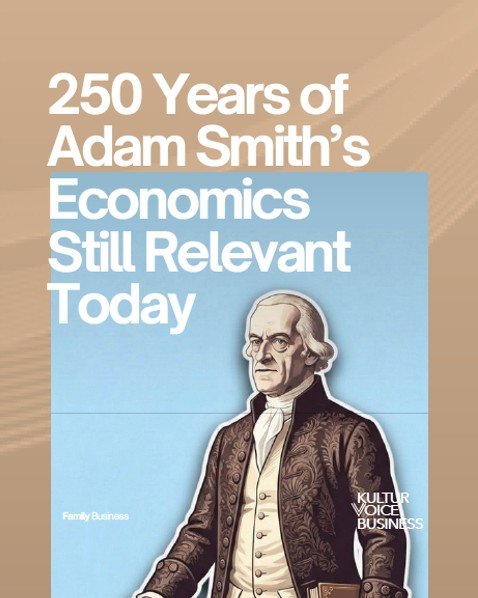

 250 years ago, a Scottish philosopher wrote a book that he unknowingly would determine the fate of the entire world’s economy. This includes Indonesia, that as part of the global economy and the world’s supply chain, Indonesia is actively expanding its access, for example through several Comprehensive Economic Partnerships that have been signed — with Australia (2020), EFTA/Switzerland (2021), UAE (2022), South Korea (2023), Canada (2024), and the European Union (2025).
Adam Smith, often called the father of modern economics, laid the foundation for the market economic system in his famous book, “The Wealth of Nations”. Adam also has 4 principles in taxation. In 1776, when the world was still dominated by empires and trade monopolies, Smith had a crazy idea: “Let the market do its own thing.”
Interestingly, today, 250 years later, we are still discussing the same idea. The relevance is even sharper in 2026, about protectionism vs. market openness, Smith has answered since the 18th century.
There are 4 main principles of Adam Smith:
1. Specialization and Division of Labor. Smith argues that the highest productivity is achieved when workers specialize in specific tasks. By breaking down production into small steps, workers become more skilled, save time, and spark the invention of machines that drastically increase efficiency.
2. “Invisible Hand” and the Free Market. Smith introduced the concept that individuals who act in search of profit will instead be driven by an “invisible hand” to benefit society. The free market regulates itself through supply and demand without excessive government intervention.
3. Economic laissez-faire (limited role of government). Smith believes that governments should minimize interference in the economy. The role of the government should be limited to protecting private property rights, enforcing laws/contracts, national defence, and providing public facilities that are unprofitable if privately managed.
4. Advantages of Free Trade. Smith encouraged free trade. Smith argued that the state should specialize in producing goods that have advantages and trading them. International trade increases the wealth of all the countries involved.
When AI threatens millions of jobs, Smith is already talking about specialization as the only shield.
Adam Smith also has 4 principles in taxation:
– Equity
– Certainty
– Convenience
– Efficiency/Economy
When your business is stagnant, Smith has explained why the market always makes room for the truly experts. It’s not a matter of boring old theories. It’s about a thinking framework that is still relevant to your business decisions today.
Adam Smith was born on 5 June 2723, in Kirkcaldy, Scotland. He attended the University of Glasgow at the age of 13 and attended Balliol College at Oxford University, where he studied European literature. Upon returning to Scotland, Smith gave a series of successful public lectures at the University of Edinburgh, helping him earn a professorship at Glasgow University in 1751. During his years spent teaching and working at Glasgow, Smith worked on getting some of his lectures published, including “The Theory of Moral Sentiments,” was eventually published in 1759. Smith moved to France in 1763 to accept a more remunerative position as a personal tutor to the stepson of Charles Townshend, an amateur economist and the future Chancellor of the Exchequer. During his time in France, Smith counted as his contemporaries Benjamin Franklin and the philosophers David Hume and Voltaire. Smith published “The Wealth of Nations” in 1776 after returning from France and retiring to his birthplace of Kirkcaldy, Scotland. He died on 17 July 1790 in Edinburgh, Scotland, and was buried in Canongate Kirkyard.
Global shifts don’t wait—and those who understand them early gain the advantage. If you want sharper perspective on trade, geopolitics, and regional dynamics, explore more on KVB.global. Share this insight with your team and follow Kultur Voice Business or KVB to stay strategically informed.
Latest news from Kultur Voice Business

SEO BACKLINKS 8 Aug 2026
I am not rattling superb with English but I line up this real easy to understand.
zimerov ertover 13 Aug 2026
Thank you for sharing with us, I think this website really stands out :D.
BonusBacklinks 19 Aug 2026
I like this website very much so much wonderful information.
Wp Seo Backlinks 5 Oct 2026
very interesting info ! .