
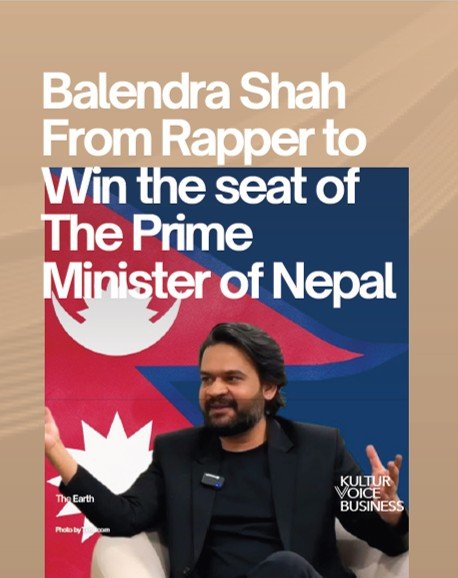

Have you ever imagined a rapper, with his streetwear style and spicy lyrics, suddenly become a real threat to the political establishment of a country – Nepal?
Meet Balendra Shah — or Balen. At just 35 years old, he is not just a musician; it is a symbol of resistance against the old rigid system in Nepal.
PURE FROM BELOW, WITHOUT FAMILY PRIVILEGES
One of the most thrilling things about Balen’s story is the background. In the world of politics, which is often a “legacy stage” for the children of officials or sons of conglomerates, Balen is an anomaly. He is purely nobody’s child. There is no big family name behind it. There is no unlimited flow of funds from a business dynasty. Balen is a structural engineer and artist who built his credibility from scratch. He did not buy sympathy with the giant billboards that filled the corners of the city, but with the lyrics of songs that voiced the unrest of the common people about corruption and poverty.
BREAKING DOWN THE WALLS OF A DYNASTY WITH AUTHENTICITY
How can an “ordinary person” defeat a political machine that is rooted for decades?
The answer: Authenticity. Balen understands that Gen Z and millennials are fed up with sweet promises wrapped in rigid protocols. He chose to be present in the community in a very human way—from giving surprises at the weddings of his supporters to serving selfies without distance. For him, leadership is not about distance, but about solid emotional connections. He proved that personal competence and integrity are much stronger than just a flashy “last name”.
NEW ERA: COMPETENCE OVER CONNECTION
Balen’s story is a reminder to all of us that the walls of conventional systems can be broken. As he stepped into Nepal’s highest seat, he brought hope to millions of other young people: that you don’t have to be born in a palace or a mansion to improve the country. The world is changing. The standards of modern leadership are now being redefined by those who dare to be honest, work hard, and come truly from the people.
Learn more about Federal Democratic Republic of Nepal, a landlocked country in South Asia.
Nepal is situated in the Himalayas and includes parts of the Indo-Gangetic Plain and borders the Tibet Autonomous Region of China to the north, and India to the south, east, and west, while it is narrowly separated from Bangladesh by the Siliguri Corridor, and from Bhutan by the Indian state of Sikkim.
Nepal has a diverse geography, including fertile plains, subalpine forested hills, and eight of the world’s ten highest mountains, including Mount Everest, the highest point above mean sea level on Earth. Kathmandu is the nation’s capital and its largest city. Nepal is a multi-ethnic, multi-lingual, multi-religious, and multi-cultural sovereign state, with Nepali as the official language.
Parts of northern Nepal were intertwined with the culture of Tibet. The centrally located Kathmandu Valley is intertwined with the culture of Indo-Aryans and was the seat of the prosperous Newar confederacy known as Nepal Mandala. The Himalayan branch of the ancient Silk Road was dominated by the valley’s traders. The cosmopolitan region developed distinct traditional art and architecture.
The country was never colonized but served as a buffer state between Imperial China and British India. Parliamentary democracy was introduced in 1951 but was twice suspended by Nepalese monarchs, in 1960 and 2005. The Nepalese Civil War in the 1990s and early 2000s resulted in the establishment of a secular republic in 2008, ending the world’s last Hindu monarchy. The Constitution of Nepal, adopted in 2015, affirms the country as a federal parliamentary republic divided into seven provinces. Nepal’s foreign policy focuses on neutrality, sovereignty, and multilateral cooperation. Nepal was admitted to the United Nations in 1955, and friendship treaties were signed with India in 1950 and China in 1960.
In September 2025, protests social media ban, economic inequality and corruption caused riots, resulting in casualties and the resignation of the prime minister.
Global shifts don’t wait—and those who understand them early gain the advantage. If you want sharper perspective on trade, geopolitics, and regional dynamics, explore more on KVB.global. Share this insight with your team and follow Kultur Voice Business or KVB to stay strategically informed.
Latest news from Kultur Voice Business


zimerov ertover 10 Aug 2026
Howdy very nice website!! Man .. Beautiful .. Wonderful .. I’ll bookmark your web site and take the feeds also…I’m satisfied to search out a lot of useful information here in the put up, we’d like develop extra strategies in this regard, thank you for sharing.