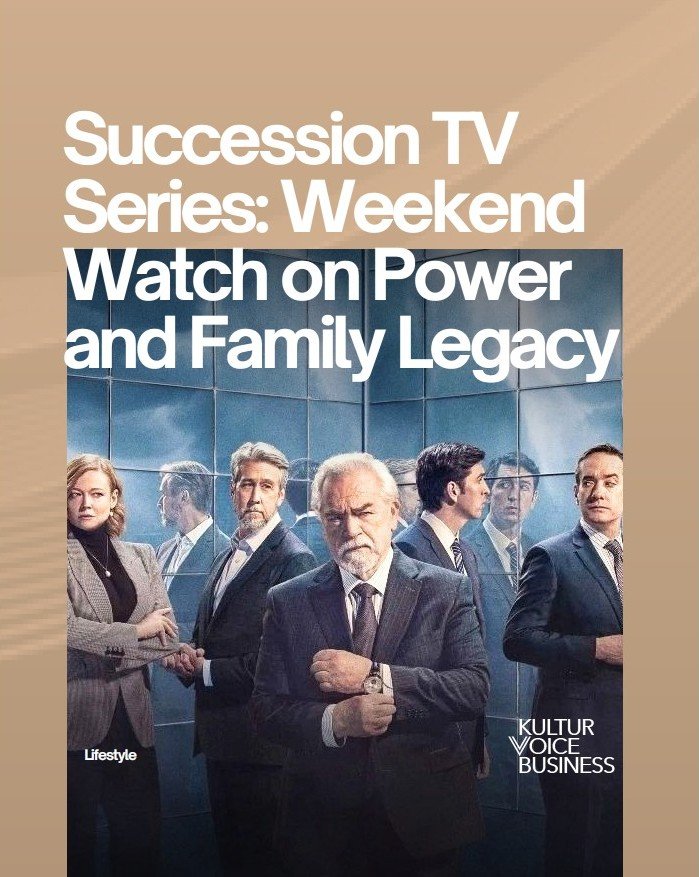

Do you have plan to watch succession in family business for weekend? Here one you can binge watch.
Succession, which won numerous prestigious accolades including three Emmy Awards for Outstanding Drama Series (2020, 2022, and 2023), explores the complexities of running a large-scale family business. The series centers on the Roy family as founder and CEO Logan Roy faces the inevitable question of succession and must decide which of his children — Kendall, Shiv, or Roman — will inherit his empire. Beyond its sharp writing and corporate drama, the series offers valuable lessons for real-world family businesses. Here are several key takeaways from Succession.
First, founders must understand when to let go. Logan Roy’s inability to release control over his empire becomes the central source of conflict throughout the series. Many founders become so deeply attached to their companies that stepping away feels like losing a part of themselves. However, succession should be viewed as a process, not a single event. A successful founder must eventually transition from being a “commander” to becoming an “advisor.” Without a clear succession timeline, the next generation is left in a prolonged state of uncertainty and dependence, unable to fully mature into leadership roles.
Second, governance must take precedence over nepotism. In Succession, positions of power are distributed according to Logan’s changing personal preferences rather than merit or capability. This creates a culture in which his children spend more time competing for parental approval than developing genuine business competence. Family businesses, therefore, need clear governance structures and merit-based standards for leadership roles. Ideally, family members should also gain experience outside the family company first, proving their capabilities independently before joining the business.
Third, founders must adopt a legacy-building approach to parenting and leadership. Logan Roy constantly pits his children against one another in an attempt to identify the “strongest” successor. In reality, sustainable family businesses thrive when family members are encouraged to develop specialized roles based on their individual strengths. While Succession appears to be about competing for the CEO position, it is ultimately a story about children seeking validation from a father who never truly gave it. When parental approval becomes the real prize, the business itself turns into a weapon used against siblings. Instead of collaborating to preserve the family legacy, they sabotage one another, leak damaging stories to the press, and prioritize personal victories over the company’s long-term interests.
 A founder who spends forty years building a business but neglects to build strong relationships with their children does not create a legacy — they create a vacuum. Without emotional security and trust, the next generation may use their inheritance not to build upon the family’s achievements, but to compensate for the emotional gaps left behind by absent or emotionally withholding parents.
Ultimately, Succession serves as a masterclass in how not to run a family business. The series demonstrates how founders who tie their entire identity to their company, refuse to let go of control, fail to establish a clear succession plan, prioritize nepotism over governance, and neglect healthy legacy-building can ultimately jeopardize the very empire they spent decades creating.
Great living is built from intentional choices—what you watch, wear, read, and practice. If you value thoughtful lifestyle and cultural insights, explore more on KVB.global. Share this article with someone who would appreciate it and follow Kultur Voice Business or KVB for curated inspiration that actually adds value.
Latest news from Kultur Voice Business