
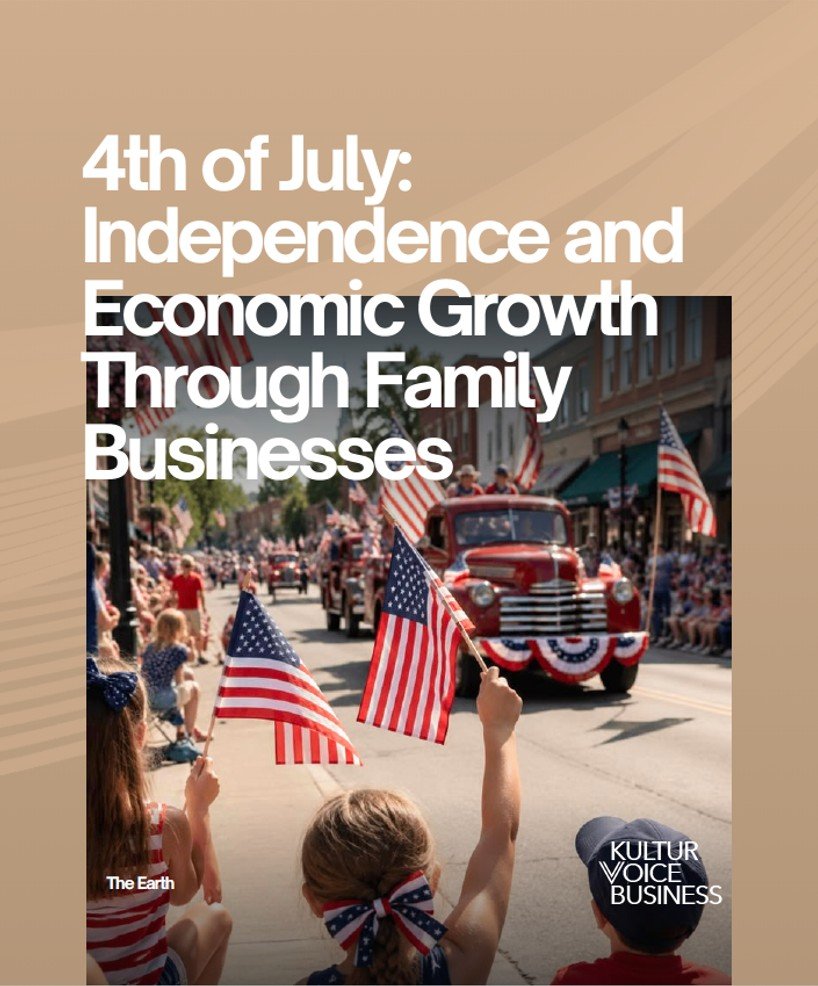

Every year on July 4, the United States celebrates Independence Day, commemorating the adoption of the Declaration of Independence in 1776. This historic moment marked the birth of a new nation founded on the ideals of liberty, democracy, and self-governance. Beyond fireworks, parades, and patriotic gatherings, Independence Day serves as a reminder of the resilience, determination, and entrepreneurial spirit that have shaped the country throughout its history.
One of the defining characteristics of the American economy is the important role played by family businesses. From small neighborhood stores and family-owned farms to large multinational corporations that began as family enterprises, these businesses have contributed significantly to economic development for generations. Family businesses often emphasize long-term planning, strong community relationships, and values that are passed down from one generation to the next.
They create employment opportunities, encourage innovation, and support local economies, making them an essential pillar of the nation’s economic foundation. Equally important is the strength of the United States financial system. The country has developed one of the world’s most sophisticated financial markets, providing businesses with access to capital through banks, investment firms, venture capital, and stock exchanges. This financial infrastructure allows entrepreneurs to transform ideas into successful companies while enabling established businesses to expand, invest in new technologies, and compete globally. A transparent regulatory framework, combined with investor confidence, has helped make the United States an attractive destination for both domestic and international investment.
Beyond its institutions, the United States has also been shaped by visionary entrepreneurs, investors, and economists whose ideas have transformed industries and influenced the global economy. Business leaders such as Steve Jobs revolutionized personal technology through innovation and design, while investors like Warren Buffett demonstrated the enduring value of disciplined, long-term investing. Influential economists including Milton Friedman, Paul Samuelson, and Alan Greenspan helped shape modern economic thought and public policy. Together, these system shapers have strengthened America’s culture of innovation, capital formation, and entrepreneurship, leaving a lasting impact that extends far beyond the nation’s borders.
The relationship between family businesses, visionary leadership, and the financial system creates a powerful engine for economic growth. Many successful American companies began as family-owned enterprises before obtaining financing to expand nationally and internationally. Access to credit and investment enables these businesses to modernize operations, create new products, and reach wider markets while preserving the values that contributed to their initial success. Combined with the contributions of innovators, investors, and economists who have shaped the nation’s economic landscape, this synergy has strengthened the country’s economy across multiple generations.
The values of freedom, opportunity, and innovation continue to inspire entrepreneurs and business owners across the country. Together, family businesses, visionary leadership, and a robust financial system demonstrate how strong institutions and private enterprise can work hand in hand to promote sustainable economic growth, create jobs, and ensure that the American economy remains dynamic and competitive in an increasingly interconnected world.
 Businessman, investor and philanthropist Warren Buffett is famed as the “Oracle of Omaha” and former CEO and current chairman of Berkshire Hathaway, who transformed it into a global conglomerate and amassed a fortune of about $149 billion. Known for value investing, modest living, and pledging 99% of his wealth to charity, he co-founded The Giving Pledge and remains an influential figure in business and philanthropy. Milton Friedman won the 1976 Nobel Prize in Economic Sciences for his work on consumption analysis, monetary history and theory, and stabilization policy. A leader of the Chicago School, he advanced monetarism, the permanent income hypothesis, and the natural rate of unemployment. Through works like Capitalism and Freedom and Free to Choose, he championed free markets, limited government, and individual liberty, influencing global economic policy. Paul Anthony Samuelson was the first U.S. Nobel laureate in Economic Sciences (1970), renowned for transforming economics into a mathematically rigorous discipline. A founder of the neo-Keynesian synthesis, he authored the seminal Foundations of Economic Analysis and the best-selling textbook Economics, advised Presidents Kennedy and Johnson, and made landmark contributions to welfare economics, international trade, finance theory, and macroeconomics. And Alan Greenspan Alan Greenspan is an American economist and former chairman of the Federal Reserve who led U.S. monetary policy from 1987 to 2006 under four presidents. Known for navigating crises from the 1987 stock market crash to 9/11, he presided over the 1990s boom but faced criticism for policies linked to the dot-com and housing bubbles. His tenure shaped the “Great Moderation” era of economic stability and sparked debates over deregulation.
American families typically celebrate it with barbecues, parades, fireworks, and patriotic activities that bring communities together. The common traditions are barbecues and cookouts featuring hot dogs, hamburgers, fried chicken, and regional specialties, alongside fireworks, parades and community events. How do you celebrate the Independence Day?
Building a resilient family business requires clarity, discipline, and long-term thinking. If you’re serious about strengthening governance, preparing the next generation, and protecting your legacy, explore more insights on KVB.global. Share this article with your partners or family members and follow Kultur Voice Business or KVB to stay ahead with perspectives that turn complexity into clarity.
Latest news from Kultur Voice Business


zimerovertover 14 Aug 2026
I haven’t checked in here for some time because I thought it was getting boring, but the last few posts are good quality so I guess I’ll add you back to my everyday bloglist. You deserve it my friend 🙂