

Family businesses need to always learn the Three-Circle model as the foundation of family business especially as business and global economies are under change. The structural complexity of a family-owned enterprise often leads to a unique set of challenges where emotional bonds and commercial logic collide. To navigate this landscape, academics and practitioners rely on the Three-Circle Model, a foundational framework developed by Renato Tagiuri and John Davis at Harvard Business School in the late 1970s. This model remains the gold standard for understanding the overlapping roles and potential conflict points within family firms.
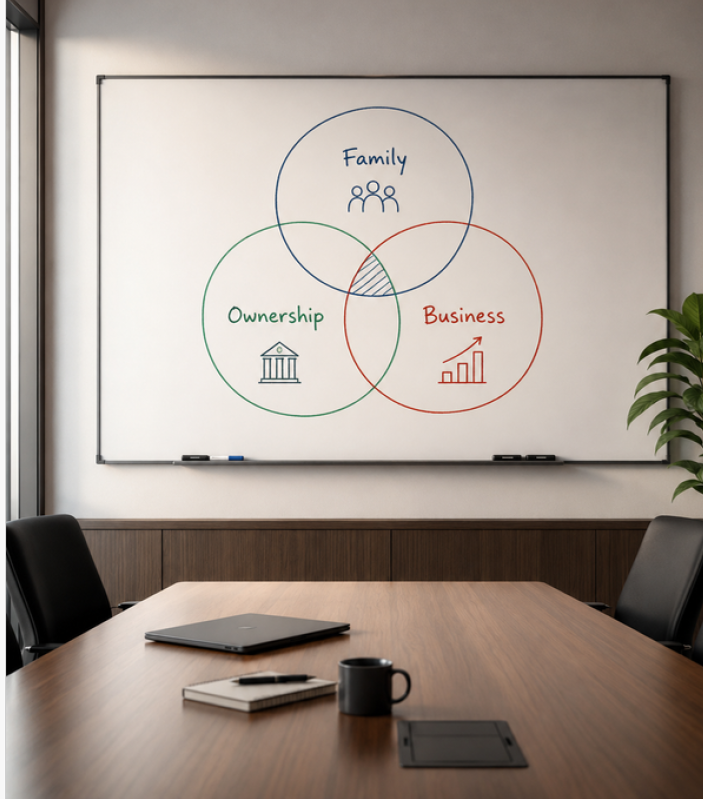
The framework posits that a family business system consists of three independent yet highly interrelated subsystems: Family, Ownership, and Business.
1. The Family Circle: Focuses on emotional health, harmony, and the development of the next generation.
2. The Ownership Circle: Concerned with ROI (Return on Investment), equity distribution, and high-level governance.
3. The Business Circle: Driven by operational efficiency, performance metrics, and professional growth.
What makes the model transformative is its identification of seven distinct sectors created by the overlapping circles. An individual might occupy only one circle (e.g., a non-family employee in business) or all three simultaneously (e.g., a founder who owns the company, manages it, and is a family member).
These overlaps are where the most significant “friction points” occur. For instance, a person in the center of all three circles must balance the unconditional love of a parent, the performance-driven mindset of a CEO, and the risk-management concerns of a shareholder.
The Three-Circle Model serves as a diagnostic tool for “dissecting” common disputes. Many family business conflicts are not personal animosities but rather role confusion. A sibling dispute over a promotion is often a clash between the “Family” logic of equality and the “Business” logic of meritocracy. By mapping individuals onto the model, stakeholders can identify where their perspectives differ based on their specific position within the system.
Furthermore, the model is dynamic. As a business moves from a “Founder-Centric” stage to a “Sibling Partnership” or “Cousin Consortium,” the weight of each circle shifts. Professionalization usually involves moving more influence into the Business circle, while succession planning focuses heavily on the transition within the Ownership circle.
Dissecting the Three-Circle Model reveals that the “messiness” of family business is actually a predictable structural phenomenon. By providing a clear language to discuss roles and boundaries, the model allows families to move away from emotional reactivity and toward strategic governance, ensuring the longevity of both the enterprise and the family bond.
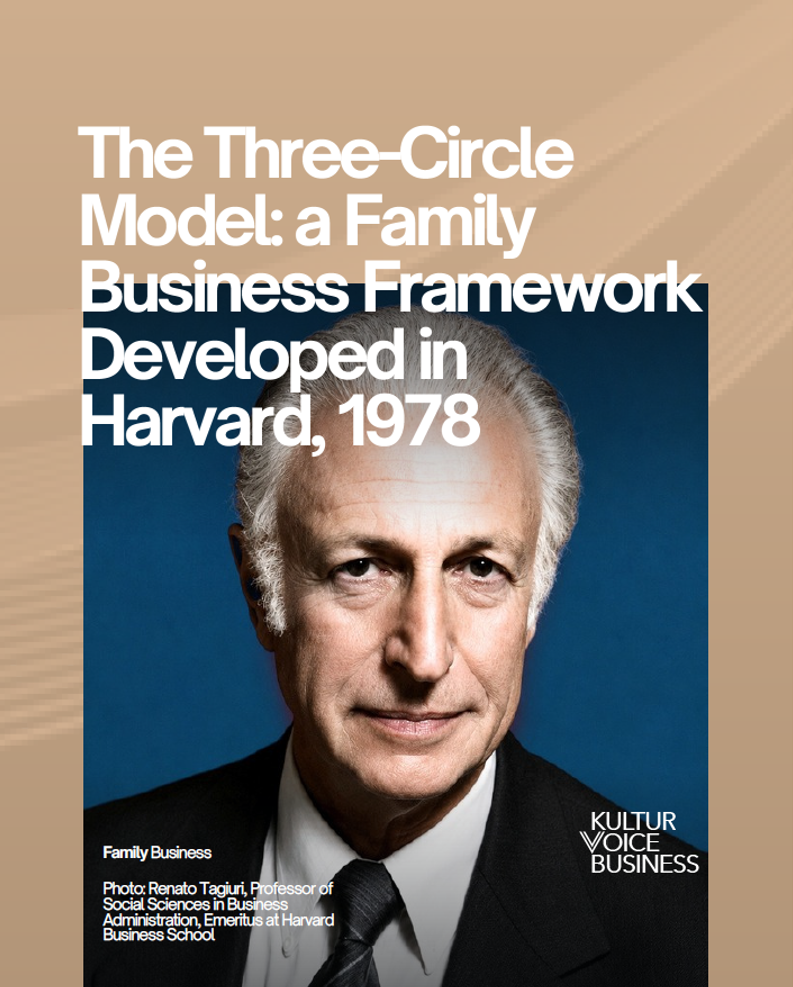
 Renato Tagiuri was an Italian professor at Harvard Business School who is very famous for his contributions in the fields of academia and management. His most iconic contribution was the development of the Three-Circle Model of the Family Business System with John Davis in the late 1970s. He was born in 1919 in Milan, Italy, was briefly taken prisoner of civil war in Britain and Canada, then earned his academic degrees in Canada and the US. He became a Professor of Social Sciences in Business Administration at Harvard and taught for more than 30 years, with a research focus on interpersonal psychology, executive personal values, and organizational climate before his passing in 2011.
John Davis is a global pioneer in the study of family business management. He taught at Harvard Business School (HBS) for 21 years. There, he founded and led the Family Business Management study area and chaired the related executive program. John Davis also wrote industry-standard books such as Generation to Generation: Life Cycles of the Family Business. After leaving Harvard, John Davis served as Faculty Director for the Family Enterprise Program at the MIT Sloan School of Management and led the consulting firm Cambridge Family Enterprise Group (CFEG).
Clarity in roles is what turns complexity into control in family enterprises. If you are building or managing a multi-generational business, explore more practical frameworks on KVB.global. Share this with your partners or family members and follow Kultur Voice Business or KVB to strengthen how you structure, decide, and lead.
Latest news from Kultur Voice Business

zimerov ertover 12 Aug 2026
I like the helpful information you provide on your articles. I’ll bookmark your blog and test again here frequently. I’m somewhat certain I will learn lots of new stuff right right here! Best of luck for the next!