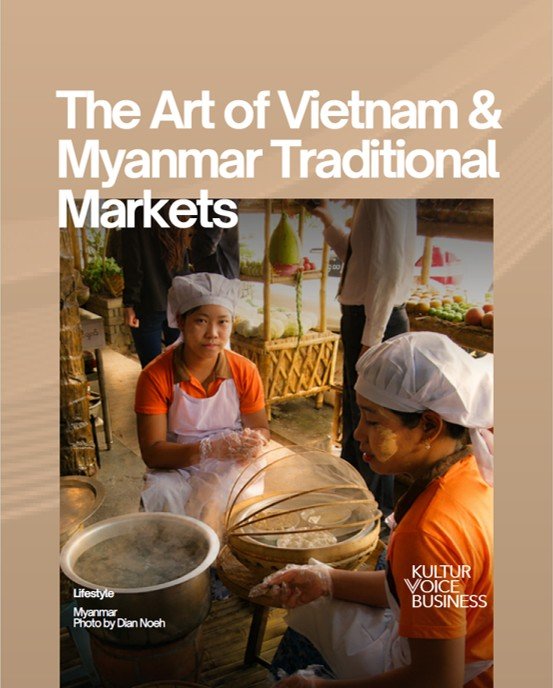

Have you been to traditional markets in Southeast Asian countries such as Vietnam and Myanmar?
Traditional markets play an important role in the daily lives of people in both Vietnam and Myanmar. These traditional markets are not only places to buy fresh vegetables, fruits, meat, and spices, but they also reflect the culture, lifestyle, and economy of each country. Despite modernization and the growth of supermarkets, farmers markets remain popular because they provide affordable goods and create strong connections between local farmers and communities.
Vietnam and Myanmar are Southeast Asian countries with large populations and significant agricultural sectors for their economies. Vietnam, with a population of over 100 million, is known as one of the world’s largest coffee producers, along with rice, pepper, and tropical fruits such as dragon fruit and lychee. Meanwhile, Myanmar, with a population of around 55 million, primarily produces rice, beans, sesame, and tea. Myanmar is also renowned for its specialty products, such as fermented tea leaves used in the traditional dish laphet thoke.
In Vietnam, traditional markets are vibrant and energetic. Markets often open very early in the morning, especially in large cities such as Hanoi and Ho Chi Minh City. Farmers from nearby villages bring fresh produce directly to the market, allowing customers to purchase high-quality ingredients at reasonable prices. Vietnam is known for its rich agricultural industry, producing rice, coffee, tropical fruits, and herbs. As a result, the markets are colourful and full of variety. Many Vietnamese people prefer shopping at traditional markets because they believe the food is fresher than products sold in supermarkets. In addition, bargaining is a common practice, making the shopping experience more interactive and livelier.
Similarly, traditional markets in Myanmar are central to local communities. These markets are often located in town centres and rural villages, serving as gathering places for both trade and social interaction. Farmers sell crops such as rice, beans, sesame, and fresh vegetables that are harvested locally. Myanmar’s markets also showcase handmade products, traditional snacks, and local crafts, giving visitors a deeper understanding of the country’s culture. Unlike modern shopping centres, farmers markets in Myanmar maintain a traditional atmosphere where people communicate closely and support local businesses.
Although Vietnam and Myanmar have different cultures and levels of economic development, their farmers markets share several similarities. Both markets emphasize fresh local products, affordable prices, and direct interaction between sellers and buyers. They also support small-scale farmers by providing opportunities to earn income without relying on large corporations. However, challenges such as urbanization, changing consumer habits, and the expansion of supermarkets may threaten the future of traditional markets.
Preserving these markets is important because they continue to support local farmers while maintaining the cultural identity of both Vietnam and Myanmar.
Vietnam, or officially the Socialist Republic of Viet Nam (SRV), is a country at the eastern edge of Mainland Southeast Asia and the world’s 16th most populous country. In the immediate aftermath of World War II, the communist-led Viet Minh coalition front launched the August Revolution and declared Vietnam’s independence from the Japan Empire in 1945. Vietnam was separated into two parts after an accord signed between Viet Minh and France. The Vietnam War later broke out between the communist North Vietnam, supported by the Soviet Union and China, and the anti-communist South Vietnam, supported by the United States. Upon the North Vietnamese victory in 1975, Vietnam reunified as a communist state that self-designated as a socialist state under the Communist Party of Vietnam (CPV) in 1976. In 1986, the CPV launched economic and political reforms like the Chinese economic reform, transforming the country to a socialist-oriented market economy. The reforms facilitated Vietnamese reintegration into the global economy and politics.
In the meantime, Myanmar or officially the Republic of the Union of Myanmar and referred to as Burma (the official English name until 1989), is a country in northwest Southeast Asia. The country’s capital city is Naypyidaw, while its largest city is Yangon (formerly Rangoon). The British East India Company seized control of the administration of Myanmar after three Anglo-Burmese Wars in the 19th century, and the country became a British colony. After a brief Japanese occupation, Myanmar was reconquered by the Allies. In 1948, Myanmar declared independence under the terms of the Burma Independence Act 1947.
Myanmar has long suffered from instability, factional violence, corruption, poor infrastructure, as well as a long history of colonial exploitation with little regard to human development. Myanmar’s post-independence history has been checkered by continuous unrest and conflict. Myanmar is one of the least developed countries in the world, being the world’s widest income gap, as a large proportion of the economy is controlled by cronies of the military junta.
If you value thoughtful lifestyle and cultural insights, explore more on KVB.global. Share this article with someone who would appreciate it and follow Kultur Voice Business or KVB for curated inspiration that actually adds value.
Latest news from Kultur Voice Business