
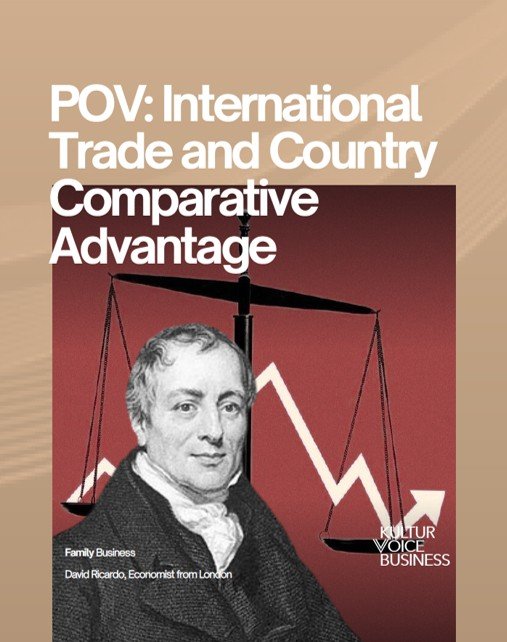

Have you ever asked why a country continues to trade in the global market even though there are other countries that are superior in many ways?
David Ricardo answered this question through the theory of Comparative Advantage. The theory of comparative advantage, introduced by a British economist, David Ricardo (1772–1823) in the early nineteenth century, is one of the most important concepts in international economics. Ricardo developed this theory to explain why countries benefit from trading with one another, even when one country is more efficient at producing all goods compared to another country. His idea challenged the belief that only countries with superior production capabilities could gain from international trade.
Comparative advantage refers to a country’s ability to produce a good or service at a lower opportunity cost than another country. Opportunity cost means the value of the next best alternative that must be sacrificed to produce something. According to Ricardo, countries should specialize in producing goods in which they have a comparative advantage and trade for products that other countries can produce more efficiently. Through specialization and trade, total global production increases, allowing all participating countries to enjoy greater economic benefits.
This concept later became one of the important foundations in the global economy and is still relevant today. Even so, this theory also has challenges, such as dependence on foreign markets and the influence of transportation costs and government policies. But in the end, Ricardo’s theory shows that cooperation and specialization can create mutual benefits for many countries.
For example, imagine two countries: Country A and Country B. Country A can produce both cloth and wine more efficiently than Country B. However, Country A is especially efficient at producing cloth, while Country B is relatively better at producing wine. Even though Country A has an absolute advantage in producing both goods, it still benefits by specializing in cloth production while Country B focuses on wine production. By trading these goods, both countries can obtain more products at lower costs than if they attempted to produce everything themselves.
Ricardo’s theory has had a lasting influence on modern globalization and international trade policies. Many countries today follow the principle of comparative advantage by exporting goods they produce efficiently and importing goods that are more costly for them to make domestically. For instance, countries rich in natural resources often export raw materials, while technologically advanced countries specialize in manufacturing or services.
Despite its importance, the theory also has limitations. Factors such as transportation costs, labour conditions, government regulations, and technological changes can affect trade patterns. Critics also argue that excessive specialization may create dependence on foreign markets and harm local industries. Nevertheless, comparative advantage remains a foundational concept in economics because it demonstrates how cooperation and specialization can create mutual benefits among nations.
In conclusion, David Ricardo’s theory of comparative advantage explains why international trade can be beneficial for all countries. By focusing on what they produce most efficiently and trading with others, nations can improve productivity, economic growth, and overall welfare.
Looking at today, global merchandise trade volume growth is projected to slow to 1.9%, down from a stronger-than-expected 4.6% expansion, as massive waves of protectionism, supply chain reconfigurations, and Middle East geopolitical shocks catch up to the global economy. While trade value reached a historic high of $35 trillion, structural cracks are deepening.
The macro trends driving commerce includes global demand for Artificial Intelligence (AI) components, ICT infrastructure, and semiconductors continues to serve as the primary engine keeping trade from contracting entirely. There is also rise of “Connector Economies”, where strategic logistics hubs like Vietnam, Cambodia, Egypt, and Indonesia have emerged as essential intermediaries to stabilize fragmented global value chains in the background of direct bilateral trade between the U.S. and China falls by roughly 25%. Other note is that the trade in commercial services is projected to expand by 4.8%, driven primarily by digitally deliverable products.
 Global trade today is marked by critical disruptions such as the closure of Hormuz Strait that severely disrupted global energy markets, and oversupply that has crashed prices for lithium, cobalt, and nickel compared to recent years. However, export restrictions keep the supply chain fragile for EV and green technology manufacturers.
David Ricardo (1772–1823) was a British economist who played a major role in shaping classical economics. Inspired by Adam Smith’s The Wealth of Nations, Ricardo developed important economic theories, including diminishing returns, economic rent, and comparative advantage—an idea that still influences modern international trade today.
Global shifts don’t wait—and those who understand them early gain the advantage. If you want sharper perspective on trade, geopolitics, and regional dynamics, explore more on KVB.global. Share this insight with your team and follow Kultur Voice Business or KVB to stay strategically informed.
Latest news from Kultur Voice Business
zimerovertover 10 Aug 2026
I truly appreciate this post. I have been looking all over for this! Thank goodness I found it on Bing. You’ve made my day! Thx again