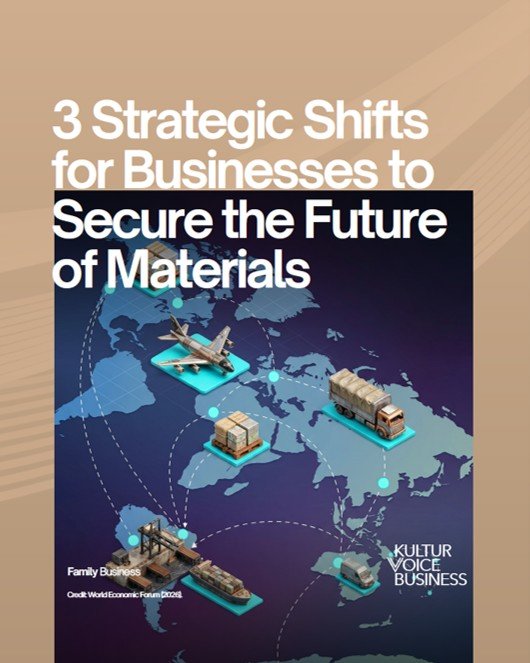


World Economic Forum (WEF) research revealed that businesses must adapt their approach to materials management through stronger international cooperation. A range of global forces is reshaping how the world operates. One of the most urgent, yet often overlooked, is materials. For decades, materials have quietly powered everything we rely on technology, energy systems, infrastructure. From copper and steel to rare earth elements, these inputs are the foundation of modern life. The world doesn’t just use materials; it depends on them.
Materials are becoming harder to manage due to a combination of rising geopolitical tensions, rapidly growing demand from new technologies, and increasing environmental pressures. What was once a stable, global system is now under strain. Supply chains are becoming more vulnerable, costs more volatile, and access less predictable.
This shift is significant, with implications across every sector of the economy, including our own. At the same time, the world is becoming more fragmented. In this multipolar landscape, global cooperation has weakened. Progress is slower, agreements are harder to reach, and countries are increasingly prioritizing their own interests. This creates a paradox: Even as cooperation becomes more difficult, it is also more critical than ever. The WEF report finds that over 90% of business leaders view global cooperation as critical and outlines key steps to achieve it.
To ensure the world continues to function smoothly, countries and companies must rethink how they collaborate on materials. This shift is not just about efficiency, but about long-term resilience and sustainability.
First, this means moving away from relying solely on large, global agreements. Instead, smaller, more flexible coalitions — built around shared interests —can move faster and deliver more practical results.
Second, businesses must embrace circular economy principles. Reusing, repairing and recycling materials is no longer just a sustainability effort, but also as a strategic necessity to reduce pressure on limited resources and build more resilient supply chains.
Third, companies and governments need to strengthen the systems that enable cooperation. This includes improving data transparency to better understand where materials come from and how they flow, aligning international standards to ensure consistency, and modernizing trade systems to support more efficient and equitable global exchange. These enablers will determine how effectively collaboration can scale across borders.
Ultimately, the future of industry will not be defined by who innovates the fastest. Instead, it will be defined by who can secure, manage and collaborate on materials most effectively. Because without materials, there is no innovation.
Resilience is the new efficiency. If you want to build stronger supply chains, explore more insights on KVB.global. Share this with your operations team and follow Kultur Voice Business or KVB to stay prepared.
Latest news from Kultur Voice Business