
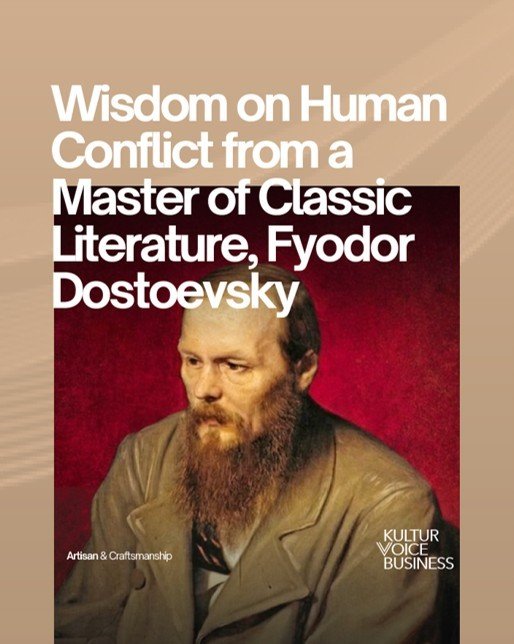


Let’s learn wisdom on Human Conflict from Fyodor Dostoesvski a Master of Classic Literature. Behind every business decision, there’s one factor that never truly changes: human nature. One writer who explored this complexity with such poignancy and remains relevant today is Fyodor Dostoevsky.
Born in Russia on 11 November 1821, Fyodor Dostoevsky was a philosopher, short story writer, and novelist widely regarded as one of the greatest figures in both Russian and world literature. His works have left a lasting influence, celebrated for their psychological depth and philosophical weight. Dostoevsky’s writing delves into the intricacies of human psychology, moral ambiguity, existential crisis, and the possibility of spiritual redemption that are often set against the turbulent social and political landscape of 19th-century Russia.
Dostoevsky was especially renowned for his ability to portray pathological states of mind, capturing emotions such as guilt, pride, despair, and self-destruction with striking intensity. This is evident in works like Notes from Underground and Crime and Punishment. Among his most influential novels, Crime and Punishment and The Brothers Karamazov stand out for their exploration of guilt, free will, faith, suffering, and the enduring conflict between good and evil.
In Crime and Punishment, Dostoevsky examines the psychological consequences of moral transgression through the character of Rodion Raskolnikov, a former student who commits a crime believing himself to be intellectually and morally superior. The novel traces his descent into paranoia, guilt, and inner turmoil, revealing how his rationalizations clash with an inescapable moral conscience. Through Raskolnikov’s journey, Dostoevsky interrogates the nature of evil, the limits of human reasoning, and the possibility of redemption, ultimately suggesting that true salvation lies not in intellect, but in humility, suffering, and compassion.
His shorter works are no less compelling. In White Nights, Dostoevsky presents a more intimate, melancholic narrative centered on loneliness and unfulfilled longing. The story follows a dreamer who briefly experiences connection and hope through a fleeting relationship, only to return to solitude. Beneath its simplicity, White Nights explores themes of emotional isolation, the human need for connection, and the quiet devastation of unreciprocated love. It also reflects how individuals, shaped by their circumstances and inner worlds, can become detached from reality and live more vividly in dreams than in life itself.
What makes Dostoevsky’s works endure is not merely their literary brilliance, but their unwavering relevance to the human experience. The themes he explores in his novels continue to mirror the struggles people face in their daily lives. Whether it is grappling with guilt, loneliness, searching for purpose, questioning belief systems, or confronting the consequences of one’s choices. Even in a modern world shaped by rapid change, his characters feel strikingly real, embodying anxieties and contradictions that remain deeply familiar. Through this timeless exploration of what it means to be human, Dostoevsky reminds readers that beneath societal progress, the core of human nature such as their fears, desires, and moral uncertainties, remains largely unchanged.
Understanding people is the foundation of every decision, business or otherwise. If you want deeper perspectives on human behaviour and leadership, explore more on Kultur Voice Business or KVB.global. Share this insight and follow Kultur Voice Business or KVB to expand how you think.
Latest news from Kultur Voice Business


zimerov ertover 12 Aug 2026
I love your writing style genuinely loving this website .