
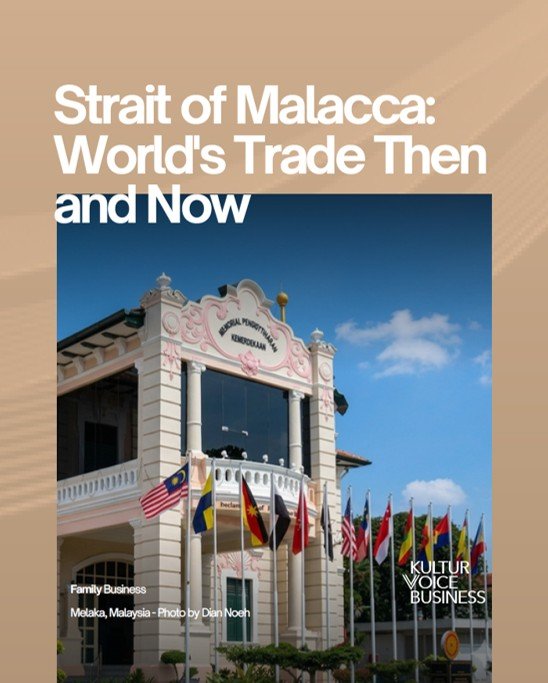

Southeast Asia, one of the culturally rich and geographically expansive regions of Asia, has a long history of economics and business. What about the Straits of Malacca today?
The rich culture of Southeast Asia makes the Strait of Malacca translated into various languages, namely Strait of Malacca (Indonesia) / Strait of Malacca (Malay) / (Malay) سلت ملاک / ช่องแคบมะละกา (Thailand) / Seulat Malacca (Aceh) / மலாக்கா நீரிணை (Tamil) / 馬六甲海峽/马六甲海峡 (Chinese).
Looking back into the past, European countries such as Portugal and the Netherlands explored the ocean and arrived in Asia and felt that they found an area that was very rich in spices that Europeans needed. Portuguese arrived in Malacca in 1511 led by Afonso de Albuquerque, who captured Malacca the city from the Malacca Sultanate. Afonso de Albuquerque was a Portuguese general, admiral, and statesman, who served as viceroy of Portuguese India from 1509 to 1515. Albuquerque was the first European of the Renaissance to raid the Persian Gulf, and he led the first voyage by a European fleet into the Red Sea. In the meantime, the Dutch arrived in 1641 and established Vereenigde Oostindische Compagnie or VOC or. The Dutch East India Company (VOC) to seize control after a long siege.
Today, Southeast Asia is strategic due to its location along major maritime trade routes. The Strait of Malacca in Southeast Asia, which is bordered by Singapore, Indonesia, and Malaysia, is one of the most important trade routes in the world. Located between the Malay Peninsula in the northeast and the island of Sumatra in the southwest, the Strait of Malacca connects the Andaman Sea (Indian Ocean) and the South China Sea (Pacific Ocean).
The Strait of Malacca connects East Asia to Europe, Africa, and the Middle East and plays a strategic role in global trade. As one of the busiest straits in the world, in 2007 more than 94,000 ships passed through this strait and transported around 25% of world trade commodities such as oil, Chinese manufacturing, coal, palm oil and coffee from Indonesia. The role of the Strait of Malacca is increasingly strategic, where in 2024 35% of oil and 20% of gas will be shipped through this strait.
The business world depends on the Strait of Malacca which follows the legal framework of the United Nations Convention on the Law of the Sea (UNCLOS) as the basis for maritime stability and free transit without barriers.
The Strait of Malacca continues to play a vital role from the spice lane to the global energy lane today. Maintaining the openness and smooth trade of the Strait of Malacca is a common interest for Southeast Asia countries.
Understanding trade routes means understanding opportunity. If your business depends on global or regional markets, explore more insights on KVB.global. Share this with your team and follow Kultur Voice Business or KVB to stay strategically informed.
Latest news from Kultur Voice Business


Serenity1218 3 May 2026
https://shorturl.fm/qHrqW