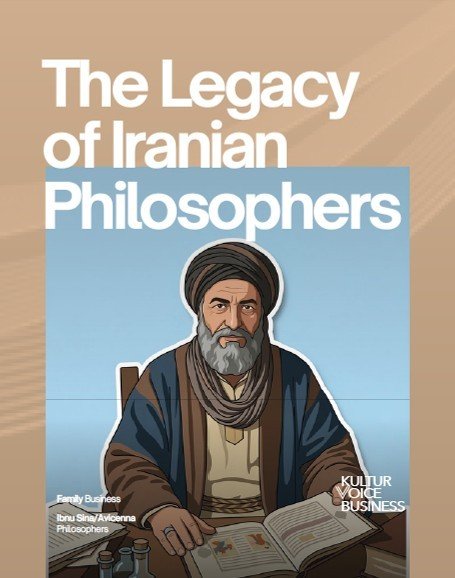

How does a civilization like Iran maintain its intellectual authority across centuries of transitions of power? The answer lies in the way they manage the inheritance.
Iran’s long history shows that this country has produced philosophers who contributed to the development of science and medicine and civilization.
Iran, with its very strong Persian majority demographic roots, understands that a solid identity is an absolute foundation before building innovation into the future.
Great philosophers such as Ibn Sina (Avicenna), Suhrawardi, and Mulla Sadra continued the thought of their predecessors. They blended the wisdom of the past—such as Greek rationality and mysticism—with the challenges of their era. This is the essence of generational transition in business: not about blindly replacing foundations but synthesizing the founder’s solid tradition with the demands of modernization.
More than that, the presence of contemporary figures such as Murtadha Muthahhari and Ali Syari’ati proves that a healthy legacy must continue to evolve. Their philosophical school, which elegantly balances the rationality of logic and the sharpness of intuition, is a blueprint example for the successors of the family business in making complex strategic decisions.
Iran is a multicultural country that has many ethnic and linguistic groups, with Persian as much as 51%. Iran, officially known as the Islamic Republic of Iran (Persian: جمهوری اسلامی ايران Jomhuri-ye Eslami-ye Iran), also known as Persia, is in Western Asia. Although the country has been known to locals as “Iran” since ancient times, until 1935 Iran was still referred to as “Persia” in the Western world. In 1959, Mohammad Reza Pahlavi announced that both terms could be used. The term Iran comes from the word “Aryan” which means “Land of the Aryan Nation”.
Iran is bordered by Azerbaijan (500 km) and Armenia (35 km) to the northwest, the Caspian Sea to the north, Turkmenistan (1,000 km) to the northeast, Pakistan (909 km) and Afghanistan (936 km) to the east, Türkiye (500 km) and Iraq (1,458 km) to the west, and the waters of the Persian Gulf and Gulf of Oman to the south. In 1979, an Iranian Revolution led by Ayatollah Khomeini established a Theocratic Islamic Republic so that Iran’s current full name is “Islamic Republic of Iran” (جمهوری اسلامی ایران).
One of the figures of Iranian descent is Christiane Amanpour. Christiane Amanpour, a British Iranian is a journalist and television host. As CNN’s Chief International Correspondent, Christiane Amanpour contributed greatly through her in-depth reporting on the Gulf War, the Bosnian War, and the genocide in Rwanda. Amanpour is also known for interviewing prominent figures such as Yasser Arafat and Mahmoud Ahmadinejad in addition to receiving awards including Emmy Awards and Peabody Awards.

Latest news from Kultur Voice Business