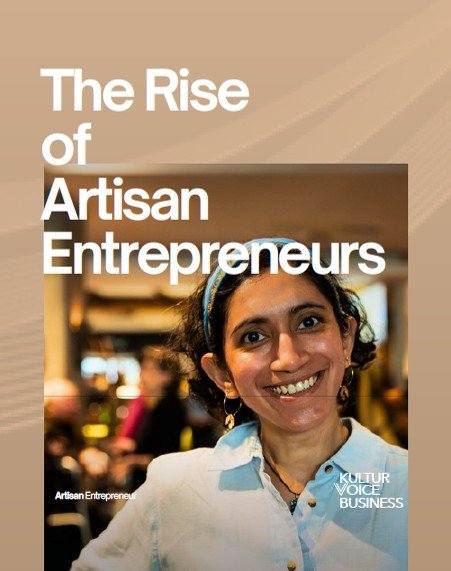

The rise of artisan entrepreneurs in an economy shows that creative economy is a pillar of the future. “Based on Badan Pusat Statistik data, throughout 2024 the value of creative exports will contribute more than 9 percent to the total national exports. By mid-2025, the value will reach 13 billion US dollars, equivalent to IDR 215 trillion or 50 percent of the 2025 target. This figure reflects the strength of the creativity and innovation-based economy that is growing in various subsectors,” said the Minister of Creative Economy, Teuku Riefky.
This growth is no longer only driven by mass production, but also by artisan entrepreneurs such as Simran Iswar who combine cultural heritage, craftsmanship with sustainable economic value.
The editorial team of Kultur Voice Business, Dygo Aheesa, invited Simran Ishwar to talk about Seni Home which she founded in 2011, as well as his passion and strategy in the midst of e-commerce growth.
Dygo: What is the background of Seni Home?
Simran: I named Seni Home because I wanted to merge two languages, namely “Seni”, which describes my love for creativity and traditional Indonesian crafts and “Home” as a means to promote talented artisans from Indonesia – who skillfully create each piece with patience. Therefore, the combination of “Seni Home” brings artisans and fans of arts and crafts to a safe private space called an art house.
Dygo: In the midst of the onslaught of fast fashion and mass printing batik, what motivates you to stay afloat as a batik entrepreneur artisan? What is the ‘soul’ or story behind the motifs you create?
Simran: Since the beginning, I have been a lover of Indonesian Batik and support batik as Indonesian cultural heritage. Besides loving batik, I also really like Indonesian handicrafts. The main focus of my products is batik on wood (batik on wood) so it is not affected by fast fashion and all my products focus on complementing the interior of the house or kitchen or as gifts/souvenirs.
I also sell Batik Tulis and Cap on request / order basis. I only support written batik and cap on batik because batik printing does not go through the traditional batik process.
Dygo: Were there any challenges in the journey of establishing and managing Seni Home?
Simran: My journey faced its own challenges due to the huge competition in the batik business. But from the beginning my intention was not to become a big business and because my focus was different from batik fabric, my business was able to continue to be stable and grow organically for 15 years.
Dygo: Batik is a very detailed traditional art, while e-commerce is fast-paced and visual. How do you translate the beauty of these batik fabric details into the gadget screen so that buyers can still feel the value of their art even if they don’t touch it directly & what is your strategy in managing Home Art?
For batik products on wood, the details are indeed done by craftsmen very carefully. Each product only has one product because it is handmade, so no one product is the same as another.
It can be said that each of our products is made of high quality and has a unique motif, making each product a limited edition. I give new ideas to the craftsmen and they also improvise their own so that the products made remain modern but also have traditional elements.
In addition, as a photographer, I choose to shoot all product photos myself. Each photo I shoot in a natural setting so that the colors and motifs look detailed and the colors look as close to the original.
Dygo: Being an artisan means the process is handmade and takes time. As orders in e-commerce explode, how do you balance maintaining authentic ‘artisan’ quality with meeting the demands of a fast-paced market?
Simran: We clearly write on our website about the purchase order process of a maximum of 3 weeks and a minimum order of 5 pieces per product. As long as I have an Seni Home business I have not experienced orders to explode because I am also careful in receiving orders.
I really maintain clear communication with buyers so that from the beginning there is an understanding of the purchase process. Communication is very important for us in maintaining trust and good relationships with customers.
Therefore, I can always maintain the maximum quality of the product. I also always provide stock so if there is a sudden order I have stock that can be an alternative for buyers.
Dygo: Looking at the theme ‘The Rise of Indonesia’s Creative Industry’, do you see a shift in buyer trends? Are young people (Gen Z/Millennial) now starting to appreciate artisan batik more than 5 years ago?
Simran: Yes, there may be a slight shift but not significantly there may be a more significant one in terms of fashion and appreciation of written batik fabrics.
It’s good for young people to appreciate Indonesian batik more, but due to the large number of batik artisans and entrepreneurs, it is a bit difficult for Gen Z children to understand what written batik actually is and why certain motifs are used.
Dygo: As a direct actor, what are your hopes for the creative industry ecosystem in Indonesia?
Simran: I hope that education about Indonesian Batik as an intangible legacy to Gen Z and the creative industry ecosystem will continue to grow. If the next generation of young people are given the right education about Batik and also encouraged to have a high appreciation for handmade works, there will certainly continue to be regeneration.
We want to keep moving forward curating spaces for people to support local arts and crafts. We hope to maintain stability and grow naturally but at the same time, promote “Wonderful Indonesia” through the beauty of Batik.
Dygo: Is there one message for other local artisans who are still afraid to enter the digital/e-commerce world?
Simran: My message is don’t be afraid to enter the digital/e-commerce world because it will make it easier for artisans to sell. Digital portals are also cost-effective. Once the process has been organized, it will make it easier for artisans to sell and buyers to access artisan products that become more affordable.
Dygo: Thank you, Mrs. Simran, for your time and inspiring story. Success always.
Craftsmanship reflects discipline, patience, and a commitment to excellence—values that translate across every industry. If you appreciate depth over noise, explore more stories on KVB.global. Share this with fellow creators and follow Kultur Voice Business or KVB for perspectives that celebrate meaningful work.
Latest news from Kultur Voice Business