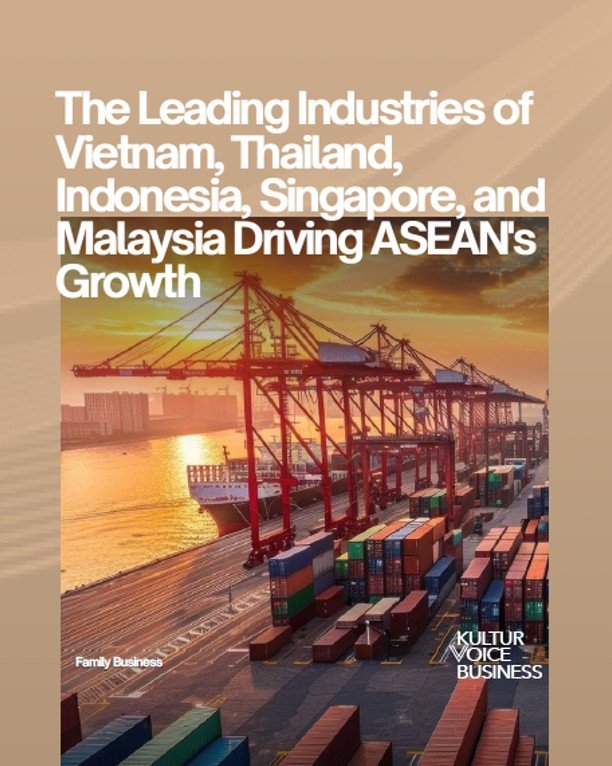

Southeast Asia continues to strengthen its position as one of the world’s most dynamic economic regions, fuelled by industries that are reshaping its role in the global economy. As multinational companies diversify supply chains and seek alternatives to traditional manufacturing hubs, Southeast Asia has emerged as one of the world’s most attractive investment destinations. Combined with rapid digital adoption and a young workforce, the region is transforming from a production base into a center of innovation, technology, and sustainable growth.
Manufacturing remains the cornerstone of Southeast Asia industrial transformation. Rather than competing in identical sectors, member countries have developed specialized strengths that complement one another. Vietnam has become a preferred destination for high-tech electronics and premium manufacturing, supported by trade agreements and a skilled workforce. Thailand continues to lead automotive and electronics production through its advanced industrial ecosystem, while Indonesia leverages its large domestic market and labor force to expand automotive assembly and electric vehicle manufacturing. This diversity enables Southeast Asia to build resilient regional supply chains while attracting global manufacturers seeking operational flexibility.
Alongside manufacturing, the digital economy is rapidly becoming a major engine of regional growth. Singapore has established itself as Southeast Asia’s leading fintech and digital services hub, while Malaysia is strengthening its position in cloud computing, AI investment, and data center infrastructure. Together with the rapid expansion of e-commerce and digital connectivity, these developments help businesses modernize manufacturing, improve logistics, and accelerate Southeast Asia’s transition toward higher-value, technology-driven industries.
However, sustaining this momentum requires more than industrial expansion alone. Governments across the region must continue investing in infrastructure, workforce development, regulatory consistency, intellectual property protection, and cross-border cooperation. As global supply chains become increasingly complex, businesses also need strategies that account for varying regulations, cultural differences, and market access across Southeast Asian markets.
With manufacturing excellence complemented by a fast-growing digital economy, Southeast Asia is positioning itself as one of the world’s most dynamic economic regions. Its combination of industrial specialization, technological transformation, and regional collaboration provides a strong foundation for long-term competitiveness. As these industries continue to evolve, Southeast Asia is set to play an increasingly influential role in shaping the future of global trade, innovation, and sustainable economic growth.
Southeast Asia is the geographical southeastern region of Asia, that is bordered to the north by East Asia, to the west by South Asia and the Bay of Bengal, to the east by Oceania and the Pacific Ocean, and to the south by Australia and the Indian Ocean.
The region lies near the intersection of geological plates, with both heavy seismic and volcanic activities. The Sunda plate is the main plate of the region, featuring almost all Southeast Asian countries except Myanmar, northern Thailand, northern Laos, northern Vietnam, and northern Luzon of the Philippines. The islands of the Philippines, Indonesia and Timor-Leste are part of the Pacific Ring of Fire. Both seismic belts meet in Indonesia, causing the region to have relatively high occurrences of earthquakes and volcanic eruptions, particularly in the Philippines and Indonesia.
Southeast Asia covers about 4,500,000 km2 (1,700,000 sq mi), which is 9.80% of Asia, 8% of Eurasia and 3% of Earth’s total land area. Southeast Asia is one of the most culturally diverse regions of the world with many different hundreds languages and ethnicities in the region. Historically, Southeast Asia was significantly influenced by Indian, Chinese, Muslim, and colonial cultures, which became core components of the region’s cultural and political institutions. Most modern Southeast Asian countries were colonised by European powers. European colonisation exploited natural resources and labour from the lands they conquered and attempted to spread European institutions to the region.
Its total population is about 676 million, about 8.5% of the world’s population, making it the third most populous geographical region in Asia after South Asia and East Asia. The eleven countries in Southeast Asia are members of the Association of Southeast Asian Nations (ASEAN), a regional organisation established for economic, political, military, educational, and cultural integration among its members.
Explore Southeast Asia’s opportunities. Read the latest stories on business, entrepreneurship, culture, and leadership across one of the world’s most dynamic regions.
Latest news from Kultur Voice Business