
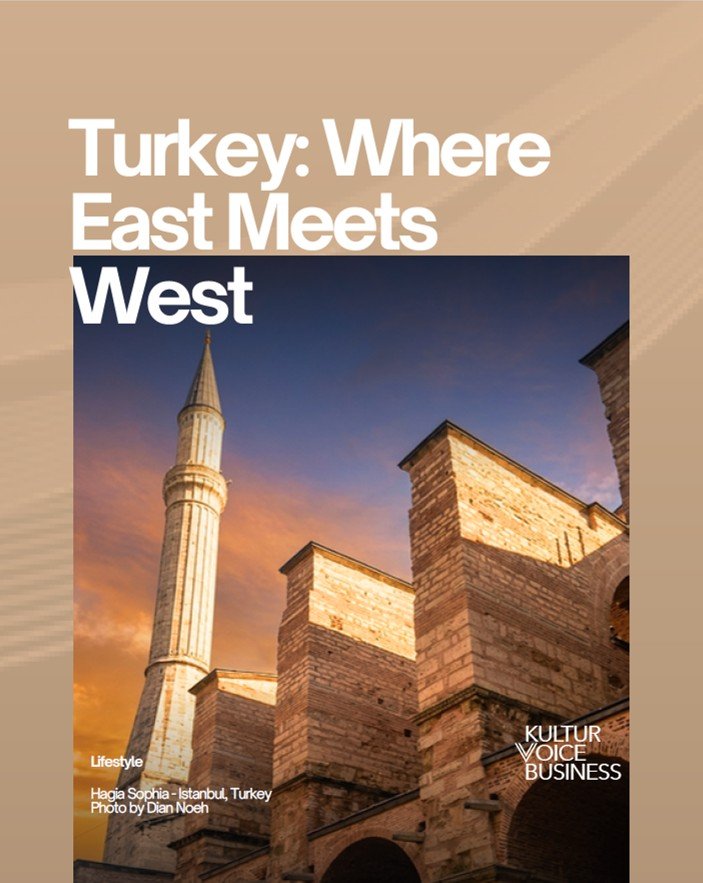

Straddling both Europe and Asia, Turkey has a charm that with ability to preserve history while embracing contemporary life. Turkey fascinates travelers with an experience that feels both timeless and modern. Turkey is a country where continents, cultures, and centuries intertwine in remarkable harmony, from the bustling streets of Istanbul to the serene coastal towns along the Mediterranean.
One of Turkey’s greatest treasures is its extraordinary historical architecture. The iconic Hagia Sophia stands as a breathtaking symbol of the country’s layered past, having served as both a cathedral and mosque across different empires. Nearby, the majestic Blue Mosque captivates visitors with its elegant domes and intricate blue Iznik tiles. Beyond Istanbul, the ancient city of Ephesus reveals remnants of Roman civilization through grand amphitheaters, marble streets, and towering columns that continue to impress historians and tourists alike.
Meanwhile, the surreal landscapes of Cappadocia, dotted with cave dwellings and fairy chimneys, showcase how nature and human creativity can coexist beautifully.
Turkey’s beauty is not limited to architecture alone. The country’s vibrant bazaars, aromatic cuisine, and warm hospitality create a lifestyle deeply rooted in community and tradition. Visitors can sip Turkish tea by the Bosphorus, wander through colorful spice markets, or watch the sunset over ancient ruins while hearing the evening call to prayer echo through the city.
At the same time, Turkey has faced economic challenges in recent years, including inflation and currency fluctuations that have affected daily life for many citizens. After a severe economic downturn in 2018, the economy began recovering in 2021 with nominal GDP reaching all-time high in 2023 and 2024, with high inflation since 2018 at 86% in 2022.
Being the world’s 16th largest economy by nominal GDP, Turkey has a diverse industrial base, strong agricultural sector and it is on the path of recovery from economic and geopolitical shocks including earthquakes in 2023 that caused over 50,000 causalities, displaced 3,3 million people, and created reconstruction at USD 81,5 billion. Turkey is a top global producer of hazelnuts, apricots and oregano with agriculture employing about 15% of the workforce and contributing more than 5% of GDB. Turkey is also a leading producer of motor vehicles, consumer electronics, home appliances and defence products.
Turkey maintains a customs union with the European Union, facilitating free trade and investments. Despite challenges Turkey has faced, Turkey continues to recover with stabilized inflation, ongoing investment, a diversified economy.
As the fourth-most-visited country globally, tourism accounted for 12% of GDP in 2023. Tourism remains a crucial pillar of Turkey’s economy, attracting millions of visitors annually and supporting local businesses, artisans and hospitality workers. Turkey continues to thrive culturally, maintaining its reputation as one of the world’s most captivating destinations. Every corner of Turkey tells a story, blending Ottoman elegance with modern energy.
Ottoman is an English term or Ottomano in Italy, or Osman Gazi was a Turkish tribal leader reigned 1299 to 1324 and the founder of the Ottoman dynasty. Through both warfare and diplomacy, he was able to unify inherited and captured lands under his rule. Successful military campaigns by his successors extended the empire deep into the Balkans to the north, and into Egypt and North Africa to the west, and eastward into the Caucasus and Anatolia.
In 1453, the city of Constantinople or Istanbul in present day, the capital of the Byzantine empire, was captured by the Ottoman sultan Mehmet II (reigned 1451–81). It remained the Ottoman capital until 1923. Mehmet II’s leadership and legacy were instrumental in the steady growth of the empire in the fifteenth and sixteenth centuries.
Ottoman cultural, political, and economic power reached its peak under Sultan Süleyman I (reigned 1520–66), his son Selim II (reigned 1566–74), and his grandson Murad III (reigned 1574–95), who all ruled from the Topkapı Palace in Istanbul. Süleyman I was known in Turkey as Kanuni (the Lawgiver) because of the numerous legal reforms he made that shaped Ottoman law for many centuries. In the West, where he was both admired and feared, Süleyman became known as “the Magnificent”—a testament to his political and cultural achievements and his reputation as a wealthy and powerful ruler.
By the eighteenth century, despite repeated efforts to reform and modernize the army and civil institutions, the vast Ottoman empire started to decline. By the nineteenth century, many of its territories in North Africa, Europe, and West Asia were lost. In 1923, Turkish Republic, established by Mustafa Kemal Atatürk, replaced the Ottoman state.
 Mustafa Kemal Atatürk, the founder and first president of the Republic of Turkey, is known as a secular figure who brought about great change by separating religion from the affairs of the state with personal views leaning towards agnostics or non-doctrinal deists. In his policy of secularism, Atatürk carried out sweeping reforms to transform Turkey into a secular modern state, in which he abolished the office of Caliph, closed courts and religious schools, adopted secular laws based on the European model, replaced the Arabic alphabet with the Latin alphabet and banned the use of veils and certain styles of clothing in public spaces. He believed that religion should be a private affair and should not interfere with the government, making him one of the most controversial but influential figures in the Islamic world in the 20th century.
Turkey became modern. Whether admired for its architectural wonders, cultural richness or breathtaking landscapes, Turkey leaves a lasting impression on everyone who visits. It is a destination where history lives on in every street and where beauty can be found in both grand monuments and everyday moments.
Great living is built from intentional choices—what you watch, wear, read, and practice. If you value thoughtful lifestyle and cultural insights, explore more on KVB.global. Share this article with someone who would appreciate it and follow Kultur Voice Business or KVB for curated inspiration that actually adds value.
Latest news from Kultur Voice Business

zimerovertover 13 Aug 2026
Hi my friend! I want to say that this post is awesome, nice written and include almost all important infos. I’d like to see more posts like this.