
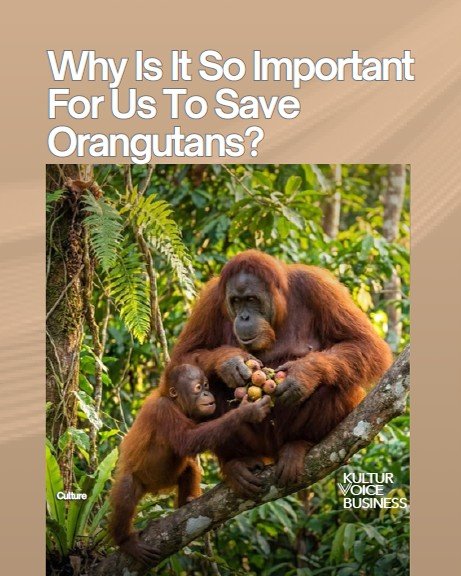

Observed each year on August 19, International Orangutan Day highlights the inseparable relationship between the survival of Asia’s only native great apes and the future of the tropical forests they inhabit.
Three Species, One Shared Dependence
Wild orangutans now live only on Borneo and Sumatra. Indonesia therefore has an exceptional responsibility for their future, as its forests support all three recognized species:
- Pongo pygmaeus — the Bornean orangutan
- Pongo abelii — the Sumatran orangutan
- Pongo tapanuliensis — the Tapanuli orangutan
Although each species occupies a distinct landscape and faces different pressures, all depend on large, connected, and healthy forest ecosystems. International Orangutan Day is therefore both a celebration of these remarkable animals and a call to examine how decisions about land use, development, and natural resources affect their survival.
An Increasingly Urgent Crisis
Orangutans face an increasingly uncertain future. Estimates suggest that roughly 119,500 remain worldwide, although reliable population counts are difficult to obtain across remote and rapidly changing forests.
Primary Threats
- Habitat loss and fragmentation: Forest conversion, logging, fires, agriculture, roads, and mining divide continuous habitat into isolated patches.
- Human–wildlife conflict: As forests shrink, orangutans have less access to food, nesting sites, and potential mates, while encounters with people increase.
- Illegal hunting and trafficking: Adult females may be killed and their infants captured for the wildlife trade.
Recovery is exceptionally slow. Females generally raise only one offspring at a time, and young orangutans remain dependent on their mothers for years as they learn where to find food, how to build nests, and how to move safely through the canopy.
Gardeners of the Forest
Orangutans are often called the “gardeners of the forest” because their daily movements help rainforests regenerate. As primarily fruit-eating primates, they carry seeds over long distances and deposit them far from parent trees.
This seed dispersal supports plant renewal, strengthens genetic diversity, and helps sustain the complex structure of tropical forests. Their feeding and nesting also create small openings in the canopy, allowing sunlight to reach younger vegetation below.
Protecting orangutans therefore safeguards far more than one species. It also helps conserve:
- watersheds and carbon-rich forests;
- habitats for countless plants and animals; and
- the food, materials, livelihoods, and cultural traditions of forest communities.
Conservation in Action
Orangutan conservation combines rescue, rehabilitation, habitat protection, scientific research, law enforcement, education, and community engagement.
Organizations Leading the Work
- Borneo Orangutan Survival Foundation: Operates a major great-ape conservation programme and has cared for and released hundreds of rehabilitated orangutans.
- Sumatran Orangutan Conservation Programme: Protects critically endangered populations through rescue, reintroduction, monitoring, veterinary care, and habitat conservation.
- WWF: Works with communities, businesses, and governments to safeguard important forest landscapes in Borneo and Sumatra.
Beyond Rescue and Release
Rehabilitation alone cannot secure the species’ future. Long-term success requires preventing further forest loss, reconnecting fragmented habitats, reducing conflict between people and wildlife, and ensuring that local communities share in the benefits of conservation.
Individuals can help by supporting reputable organizations, choosing responsibly sourced products, understanding how consumption affects forests, and sharing accurate conservation information.
Cultural Significance and Learned Traditions
Orangutans hold deep cultural and symbolic significance in Indonesia and the wider region. Their name comes from the Malay and Indonesian words orang and hutan, meaning “person of the forest”—a phrase inspired by the human-like qualities people have long observed in them.
These intelligent, adaptable animals learn behaviors that can differ from one population to another. Young orangutans gain essential knowledge by observing their mothers, while some groups use leaves, sticks, and other natural materials in distinctive ways.
The disappearance of a local population can therefore mean more than a decline in numbers—it can erase behaviors and knowledge developed over generations. Orangutans embody both the biological richness of Asia’s rainforests and the cultural relationships people have formed with these landscapes.
A Shared Commitment to the Future
Protecting the “people of the forest” is more than a conservation mission. It is a commitment to preserving Asia’s irreplaceable biodiversity, maintaining forests that store carbon and regulate water, and respecting the cultural identities connected to rainforest landscapes.
The future of orangutans depends on whether governments, businesses, communities, and individuals can balance development with responsible stewardship. Their survival would show that economic progress and ecological protection need not be opposing goals.
By keeping forests standing—and ensuring that orangutans can move, feed, reproduce, and thrive within them—society protects not only an extraordinary great ape, but also the living systems on which future generations depend.
Grow your voice across Southeast Asia.
Partner with KVB through our media platform, content production services, public relations agency, and GigHub freelance ecosystem to reach business audiences across the region.
Latest news from Kultur Voice Business

Hannah Evans 25 Aug 2026
I genuinely felt calmer by the end of this
Abdiel Dangelo Montes 26 Aug 2026
Love this appreciation for great content