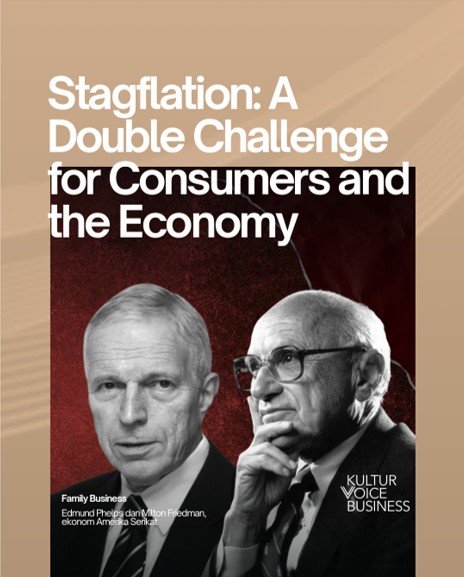

What does stagflation mean for consumers and businesses? We need to learn about the situation brought by economist Phillips Curve who passed away recently.
Stagflation is an economic condition characterized by the unusual combination of high inflation, slow economic growth, and high unemployment. Traditionally, economists believed that inflation and unemployment had an inverse relationship, as described by the Phillips Curve. However, the stagflation occurred in many countries during the 1970s challenged this assumption and led to new economic theories explaining how inflation and stagnation can occur simultaneously.
According to economists Milton Friedman and Edmund Phelps, stagflation occurs when inflationary expectations become embedded in the economy. Prior to their work, many policymakers believed that increasing inflation could permanently reduce unemployment. Friedman and Phelps argued that this effect would only be temporary. Once workers and businesses expect prices to continue rising, they demand higher wages and adjust prices accordingly. As a result, inflation accelerates without producing long-term employment gains. Friedman introduced the concept of the “natural rate of unemployment”, suggesting that attempts to push unemployment below this level through expansionary monetary policies would ultimately lead only to higher inflation.
Stagflation can also be triggered by supply-side shocks, which reduce the economy’s productive capacity while increasing costs. A notable example was the 1973 OPEC oil embargo, which sharply increased energy prices worldwide. Higher production costs forced businesses to raise prices, contributing to inflation, while reduced output and investment slowed economic growth and increased unemployment. Supply-side economists further argued that excessive taxation and government regulations can worsen stagflation by limiting aggregate supply and discouraging business expansion.
The impact of stagflation on consumers is significant. Rising prices reduce purchasing power, making everyday goods and services more expensive. At the same time, slower economic growth often leads to job losses and lower wage growth, creating financial pressure for households. Consumers may find it difficult to maintain their standard of living as both employment opportunities and real incomes decline.
To cope with stagflation, businesses can focus on improving efficiency, reducing unnecessary costs, and diversifying supply chains to manage rising input prices. Consumers can respond by budgeting carefully, reducing discretionary spending, building emergency savings, and investing in assets that may better preserve value during inflationary periods. Meanwhile, policymakers often rely on a combination of monetary restraint and supply-side reforms to control inflation while encouraging long-term economic growth. Although stagflation presents serious challenges, understanding its causes can help businesses, consumers, and governments respond more effectively.
Milton Friedman was an American economist, statistician, awarded with the 1976 Nobel Memorial Prize in Economic Sciences for his research on consumption analysis, monetary history and theory, and the complexity of stabilization policy. He introduced the permanent income hypothesis, a theory which would later become part of mainstream economics, and he was among the first to propagate the theory of consumption smoothing. Friedman promoted a macroeconomic viewpoint known as monetarism and argued that a steady, small expansion of the money supply was the preferred policy, as compared to rapid and unexpected changes. His ideas concerning monetary policy, taxation, privatization, and deregulation influenced government policies, especially during the 1980s. His monetary theory influenced the Federal Reserve’s monetary policy in response to the 2008 financial crisis.
Friedman was among the intellectual leaders who rejected Keynesianism in favor of monetarism before shifting their focus to new classical macroeconomics in the mid-1970s. During the 1960s, he became the main advocate opposing both Marxist and Keynesian government and economic policies and described his approach (along with mainstream economics) as using “Keynesian language and apparatus” yet rejecting its initial conclusions. Milton Friedman was born on 31 July 1912 and passed away on 16 November 2006.
Edmund Phelps was an American economist, awarded and recipient of was an American economist and the recipient of the 2006 Nobel Memorial Prize in Economic Sciences.
 He became known for his research on the sources of economic growth during his early career in 1960s at Yale’s Cowles Foundation in the first half of the 1960s. Phelps was at the University of Pennsylvania from 1966 to 1971 and moved to Columbia University in 1971. His most seminal work inserted a microfoundation, one featuring imperfect information, incomplete knowledge and expectations about wages and prices, to support a macroeconomic theory of employment determination and price-wage dynamics. In the early 2000s, he turned to the study of business innovation and was the founding director of Columbia’s Centre on Capitalism and Society in 2001. Phelps, who was born on 26 July 1933, was McVickar Professor Emeritus of Political Economy at Columbia University in 2022, before he passed away recently on 15 May 2026.
If you want sharper perspective on trade, geopolitics, and regional dynamics, explore more on KVB.global. Share this insight with your team and follow Kultur Voice Business or KVB to stay strategically informed.
Latest news from Kultur Voice Business