
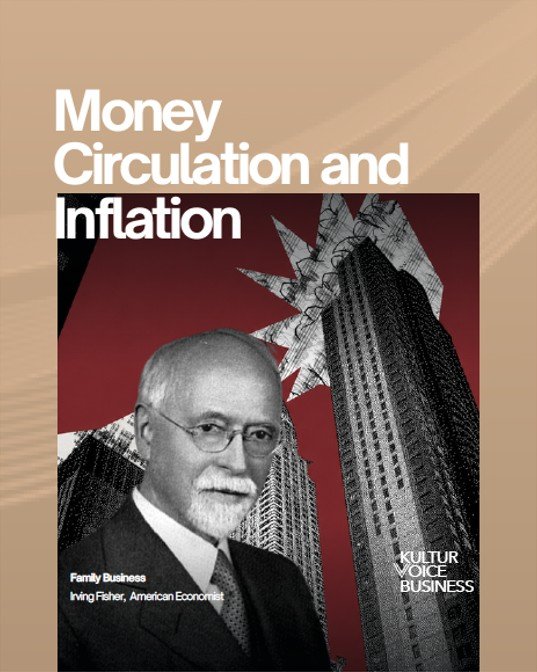

When we are thinking about money, inflation and price we pay on daily basis, we can refer to the Quantity Theory of Money as one of the most influential theories in monetary economics.
Developed in the early twentieth century by an American economist Irving Fisher, who was considered a pioneer of modern economic thought, the Quantity Theory explains the relationship between the quantity of money in an economy and the general level of prices.
Fisher, who is best known for his work on interest rates, capital theory, money, and inflation, argued that changes in the money supply directly affect the value of money and the level of economic activity.
The foundation of Fisher’s theory is the famous Equation of Exchange: MV = PT
In this equation, M represents the quantity of money in circulation, V stands for the velocity of money (the number of times money changes hands during a given period), P denotes the average price level, and T refers to the volume of transactions in the economy. According to Fisher, the total amount of money spent in an economy (MV) must equal the total value of goods and services exchanged (PT).
A key assumption of Fisher’s theory is that the velocity of money and the volume of transactions remain relatively constant in the short run. Under these conditions, any increase in the money supply will lead to a proportional increase in the price level. For example, if the amount of money in circulation doubles while V and T remain unchanged, prices will also double. As a result, the purchasing power of money decreases because more money is required to buy the same goods and services.
The Quantity Theory of Money highlights the important role of monetary policy in controlling inflation. Governments and central banks can influence economic stability by regulating the money supply. If too much money is introduced into the economy, inflation may occur. Conversely, a restricted money supply may reduce spending and slow economic growth.
Despite its significance, Fisher’s theory has faced criticism. Economists have argued that the velocity of money is not always stable and that changes in consumer behaviour, financial innovations, and economic conditions can affect how money circulates. Additionally, modern economies are more complex than the model assumes, making the direct relationship between money supply and prices less predictable.
In conclusion, Irving Fisher’s Quantity Theory of Money provides a fundamental framework for understanding the relationship between money supply and price levels. Although some of its assumptions have been challenged, the theory remains an essential concept in economics and continues to influence discussions on inflation, monetary policy, and economic management.
Irving Fisher was an American economist, statistician, inventor, and professor, born on 27 February 1867, in Saugerties, New York, United States. He spent most of his academic career at Yale University, where he taught economics and became one of the most influential economists of the early 20th century. He published poetry and works on astronomy, mechanics, and geometry. Fisher earned the first Ph.D. in economics ever awarded by Yale. After graduation he stayed at Yale for the rest of his career.
Irving Fisher was one of America’s greatest mathematical economists and one of the clearest economics writers of all time. He had the intellect to use mathematics in virtually all his theories and the good sense to introduce it only after he had clearly explained the central principles in words. Fisher also wrote Theory of Interest so clearly that graduate economics can read and understand half the book in one sitting, something unheard of in technical economics. Similarly, monetarism is founded on Fisher’s principles of money and prices.
Fisher was a pioneer in the construction and use of price indexes and the first economist to distinguish clearly between real and nominal interest rates. He pointed out that the real interest rate is equal to the nominal interest rate (the one we observe) minus the expected inflation rate.
 He was a founder or president of numerous associations and agencies, including the Econometric Society and the American Economic Association. He was also a successful inventor. In 1925 his firm, which held the patent on his “visible card index” system, merged with its main competitor to form what later was known as Remington Rand and then Sperry Rand. Although the merger made him very wealthy, he lost a large part of his wealth in the stock market crash of 1929.
Global shifts don’t wait—and those who understand them early gain the advantage. If you want sharper perspective on trade, geopolitics, and regional dynamics, explore more on KVB.global. Share this insight with your team and follow Kultur Voice Business or KVB to stay strategically informed. You also can email us at hello@kvb.global for Public Relations services, content production and future work.
Latest news from Kultur Voice Business


zimerovertover 12 Aug 2026
I went over this web site and I conceive you have a lot of good information, saved to fav (:.