
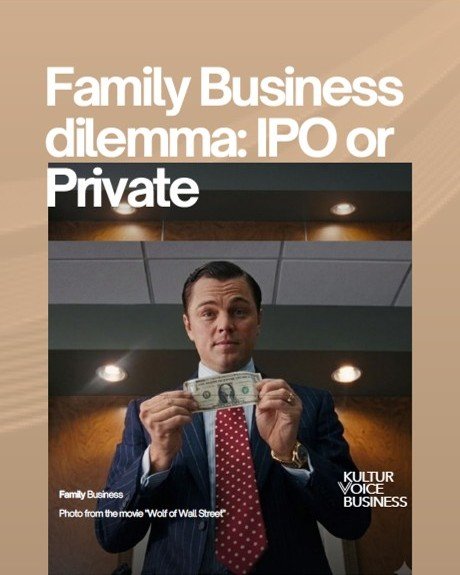


In family business architecture, IPO is one of the most crucial things for a company. In family business, choosing between maintaining absolute control or surviving and expanding without external funding is substantial.
An Initial Public Offering (IPO) is often seen as the pinnacle of corporate achievement. Listing on the stock exchange injects massive capital that allows the acceleration of global expansion, strategic acquisitions, and market share dominance in a short period of time, in addition to having a positive impact on reputation, namely increasing corporate reputation, brand awareness, and consumer confidence. However, public capital is not a free fund; it is paid by dividing authority. Executives must now respond to shareholder demands by pursuing aggressive quarterly growth targets and transparency as a form of responsibility to shareholders as well as corporate and retail investors.
On the other hand, maintaining a private status is about maintaining the purity of vision. Being a closed company gives you the greatest privilege in business: flexibility and time. You’re free from the media’s sharp spotlight, tiresome transparency regulations, and short-term dividend pressures. Strategic maneuvers can be designed in silence and executed with full agility, preserving the founder’s pure legacy.
There is no absolute right or wrong path, there is only which path is most precise with the DNA and growth phase of your business entity right now. What you always need is a family business: IPO is not a goal. It’s a consequence of readiness.
IPO readiness starts from the foundation that the company has before the IPO process:
– Financial Stability: Companies need a track record of steady earnings, positive cash flow, and clear growth potential, alongside audited, transparent, and consistent financial reporting.
– Corporate Governance: A robust governance framework is required to ensure transparency, meet regulatory standards, and manage increased stakeholder accountability.
– Valuation and Due Diligence: Investment bankers, accounting firms, and lawyers are hired to analyze company value through methods like discounted cash flow (DCF) or comparable company analysis, ensuring the firm is ready for public scrutiny.
– Market Readiness: The company must prepare for the immense pressure of public market expectations, which can impact company culture and internal processes. You need a communications team, specialist or agency to manage your content and reputation including ESG, like Content Office .
There is also a fairly long IPO process, including:
– Appointing the underwriters: Hiring investment banks to manage the process.
– Due Diligence and Filing: Preparing a prospectus (Red Herring) with SEC or equivalent regulatory authorities.
– Roadshow and Pricing: Promoting the shares to potential investors to determine the final offer price.
– Listing: Shares begin trading on a stock exchange, marking the completion of the IPO and a new journey that requires responsibility and accountability.
Learning the above, which path is the most appropriate for your company today?
Readiness—not hype—determines long-term success. If you are building toward scale, explore more insights on KVB.global. Share this with your leadership team and follow Kultur Voice Business or KVB to grow with discipline.
Latest news from Kultur Voice Business


zimerovertover 12 Aug 2026
Precisely what I was searching for, regards for putting up.