

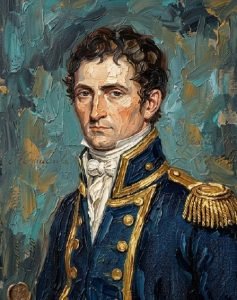
In the early 19th century, Captain Matthew Flinders, an English explorer, carved out his greatest masterpiece of navigation. Captain Matthew Flinders became the first man to map the coastline of the southern continent in its entirety and gave it the permanent identity we know today: Australia.
The historic expedition not only expanded the boundaries of human knowledge but also laid the foundation for the birth of a new economic zone in the southern hemisphere. More than two centuries later, the land that Flinders mapped has transformed into one of the main pillars of the global supply chain.
Indonesia and Australia are not just geographical neighbors, but together they are members of the Asia-Pacific Economic Cooperation (APEC) along with 19 other countries in the Pacific Rim, making up 40% of the world’s population, half of global trade and 60% of global GDP. The earliest trade relationship between Indonesia and Australia is recorded as having Bugis and Makassar fishermen regularly sail to northern Australian waters since 1650, during the Gowa Kingdom in Makassar. They sailed in the form of a fleet of 30 to 60 boats, and each one loaded up to 30 people with the aim of finding sea cucumbers which were then exported to China. The sea cucumber fishermen built temporary houses, dug wells and planted sour trees. The small forest of tamarind trees still exists today. Many of the Aboriginal people who worked for the tripang fishermen learned their language, used tobacco-smoking habits, made boat drawings, learned their dances and ‘borrowed’ some of the stories they told.
Indonesia-Australia relations continue to grow and then have the Indonesia Australia Comprehensive Economic Partnership, a strategic agreement where bilateral trade flows between the two countries move dynamically, including the exchange of agricultural commodities, mineral energy, and high-value technology investments. Indonesia Australia Comprehensive Economic Partnership (IA CEPA) was signed in March 2019, ratified by Australia in November 2019 and by Indonesia in February 2020.
IA CEPA is important as
– It eliminates tariffs on nearly all goods traded between Indonesia and Australia.
– Australia companies are allowed to hold majority stakes in Indonesia firms in sectors such as telecommunications, transport, health, energy.
– It includes provisions for services trade, ecommerce and investor-state dispute settlement, and intellectual property protection.
– Opportunities for Indonesians to work in Australia through Working Holiday Visa.
– Australian universities can establish branch campuses in Indonesia.
– The agreement supports workplace placements for up to 12 months in the other country, enhancing skills and fostering mutual understanding between Australian and Indonesian employees.
Since its implementation, IA-CEPA has doubled traded between Indonesia and Australia within five years, strengthened employment, economic growth and resilience in both countries.
This brings us to Flinders’ exploration that reminds us that true discovery is not just about discovering new lands, but about paving the path of long-term prosperity for future generations. Today’s Indonesia-Australia trade relationship is a perfect manifestation of the vision of an ever-expanding civilization.
Among the agriculture, energy, or technology trade sectors, which sector do you think has the highest investment potential between Indonesia and Australia at the moment?
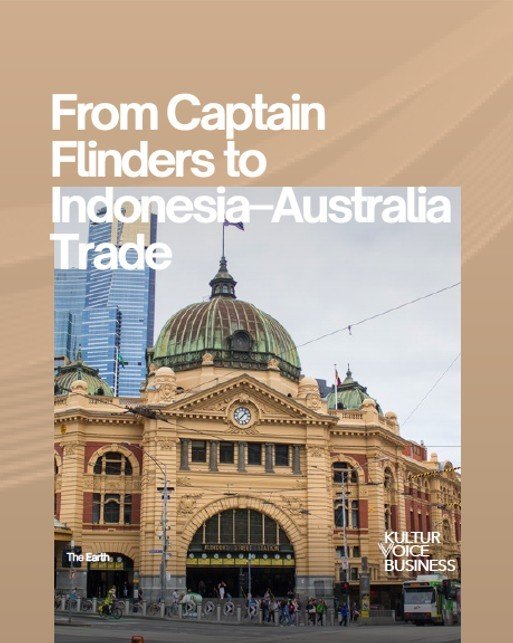
Captain Flinders’ name was also used as the name of a street, Flinders Street in Melbourne, in honour of Captain Flinders. This naming was based on the erroneous belief at the time that he was the first to discover Port Phillip Bay, the area where Melbourne was later founded. On Flinders Street itself, Flinders Station was established, Flinders Street Station is a cultural icon and a major transport hub in Melbourne, Australia, located at the corner of Flinders and Swanston Street. Opened in 1910 with distinctive yellow-green French Renaissance architecture, it is Australia’s oldest railway station and one of the busiest in the southern hemisphere, famous for its iconic row of clocks at its entrance.
A quick note about Flinders Street Station:
– It is on the banks of the Yarra River, in the heart of Melbourne’s downtown (CBD), adjacent to Federation Square.
– Iconic features with a green copper dome, yellow façade and a popular train departure indicator clock – meet me under the clocks
– It is the first steam railway station in Australia (1854) and has a 708-metre-long main platform, one of the longest in the world.
– It serves most of the suburban and regional metro train lines of the V/Line.
– The Hidden Room on the upper floor of the station was a popular ballroom and is now occasionally open for art exhibitions
– Flinders Station is listed on the Victorian Heritage Register and is a must-visit landmark in Melbourne
Kultur Voice Business editorial team recommended readers to visit Flinders Station in Melbourne too, as part of learning about Australia and its international trade.
If this perspective matters to your business or worldview, dive deeper into KVB.global for grounded insights on circular thinking, global shifts, and responsible leadership. Share this with your network and follow Kultur Voice Business or KVB to stay informed on what truly shapes our future.
Latest news from Kultur Voice Business


zimerovertover 14 Aug 2026
This design is spectacular! You most certainly know how to keep a reader entertained. Between your wit and your videos, I was almost moved to start my own blog (well, almost…HaHa!) Wonderful job. I really loved what you had to say, and more than that, how you presented it. Too cool!