
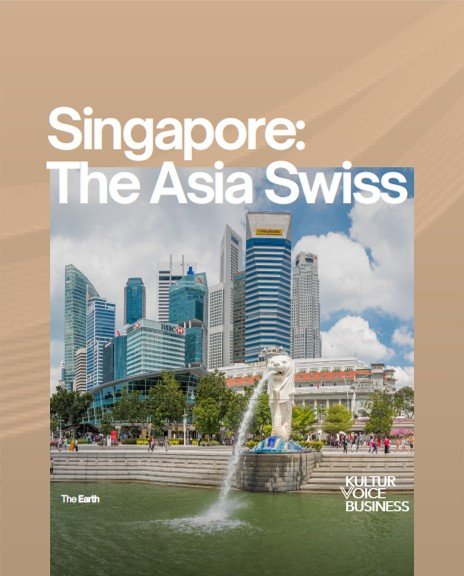

 How can a small country with no natural resources like Singapore transform into one of the world’s financial centers and the hub of many global companies?
The answer lies not only in economic policy, but also in the cultural roots that drive it. Widely known as the “Switzerland of Asia”, Singapore’s governance success is heavily influenced by strong work ethic values, high levels of discipline, adherence to the rule of law, and well-organized social harmony. This cultural foundation facilitates the execution of Lee Kuan Yew’s great vision of leadership.
Singapore has succeeded in building an economic ecosystem that relies on political stability, geopolitical neutrality, and the rule of law without compromise.
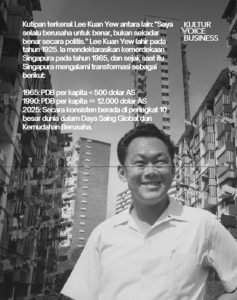
Lee Kuan Yew declared Singapore’s independence in 1965 and Singapore has made remarkable progress as follows:
1965: GDP per capita below $500
1990: GDP per capita to $12,000
2025: Consistently ranked in the top 10 for Global Competitiveness and Ease of Doing Business
With highly efficient pro-business regulations — such as no capital gains tax — Singapore has cemented its position as Asia’s premier private banking and
wealth management mecca in Asia. A very low level of corruption provides peace of mind or confidence for investors to turn their capital safely.
Singapore, along with Indonesia, Malaysia, Thailand, and the Philippines are key countries in Southeast Asia and together they are members of the Southeast Asia Nation. Singapore is the country that invests the most in Indonesia.
Lee Kuan Yew was born in 1925, a Buddhist/Taoist and one of his most prominent statements was: “I always tried to be correct, not politically correct.”
The synergy between the discipline of East Asian philosophy and the modern Western financial system is the true blueprint behind Singapore’s charm.
Lessons on leadership from Lee Kuan Yew are:
1. Say It As It Is, Straightforward. Honesty that makes him respected by others. Moreover, credibility is a vital thing for a leader to have.
2. Plan for leadership succession by making the organization run according to the mission and system, not because of the leader.
3. Stay resilient in the midst of many challenges and pressures.
If you’re serious about strengthening governance, preparing the next generation, and protecting your legacy, explore more insights on KVB.global. Share this article with your partners or family members, and follow Kultur Voice Business or KVB to stay ahead with perspectives that turn complexity into clarity.
Latest news from Kultur Voice Business


zimerov ertover 10 Aug 2026
Some really excellent content on this website , regards for contribution.