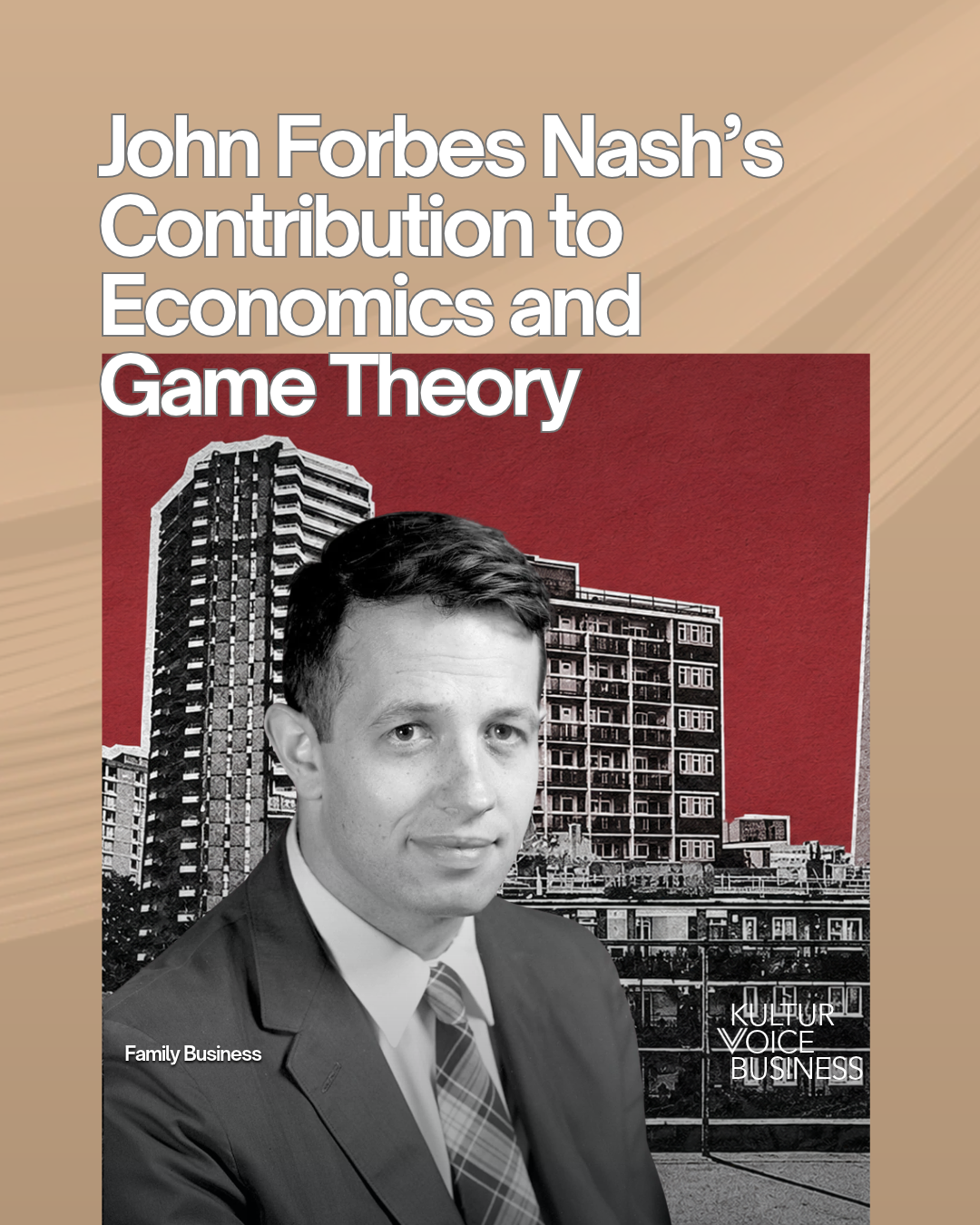

John Forbes Nash Jr. (1928–2015) was an American mathematician best known for his groundbreaking contributions to economics through game theory. Born in Bluefield, West Virginia, Nash demonstrated exceptional mathematical abilities from an early age. He studied at Carnegie Institute of Technology before pursuing his doctoral degree at Princeton University, where he developed his influential ideas about strategic decision-making. In 1994, he received the Nobel Memorial Prize in Economic Sciences, alongside John Harsanyi and Reinhard Selten, for their pioneering analysis of equilibria in the theory of non-cooperative games.
Nash’s most significant contribution to economics was the development of the Nash Equilibrium, a fundamental concept in game theory. Game theory examines how individuals, businesses, or organizations make decisions when their outcomes depend not only on their own choices but also on the decisions of others. Before Nash’s contribution, economic game theory primarily focused on situations where one participant’s gain directly resulted in another participant’s loss. Nash expanded this understanding by introducing a framework for analyzing situations involving multiple decision-makers with different interests.
The Nash Equilibrium describes a situation in which every participant has chosen the best possible strategy based on the decisions of others. In this condition, no participant can improve their outcome by changing their strategy independently. For example, two competing companies deciding on product prices must consider not only their own profitability but also how their competitors might respond. Their decisions eventually reach a point where neither company benefits from changing its strategy alone. This concept helps economists understand competition, negotiations, pricing strategies, and market behavior.
Another important contribution was the Nash Bargaining Solution, which provides a mathematical approach to understanding how two parties can reach mutually beneficial agreements. This theory helps explain how individuals or organizations negotiate when they have different preferences but share an interest in reaching an agreement.
Nash’s contributions have had a lasting impact on individuals and society. His theories are applied in business, politics, international relations, auction systems, and even biology. They help governments, companies, and individuals anticipate the possible consequences of their decisions and understand the importance of considering other people’s interests. Beyond economics, Nash’s work demonstrated how mathematical thinking could provide valuable insights into human behavior and social interactions. His legacy continues to shape modern economic research and our understanding of decision-making in an interconnected world.
Latest news from Kultur Voice Business