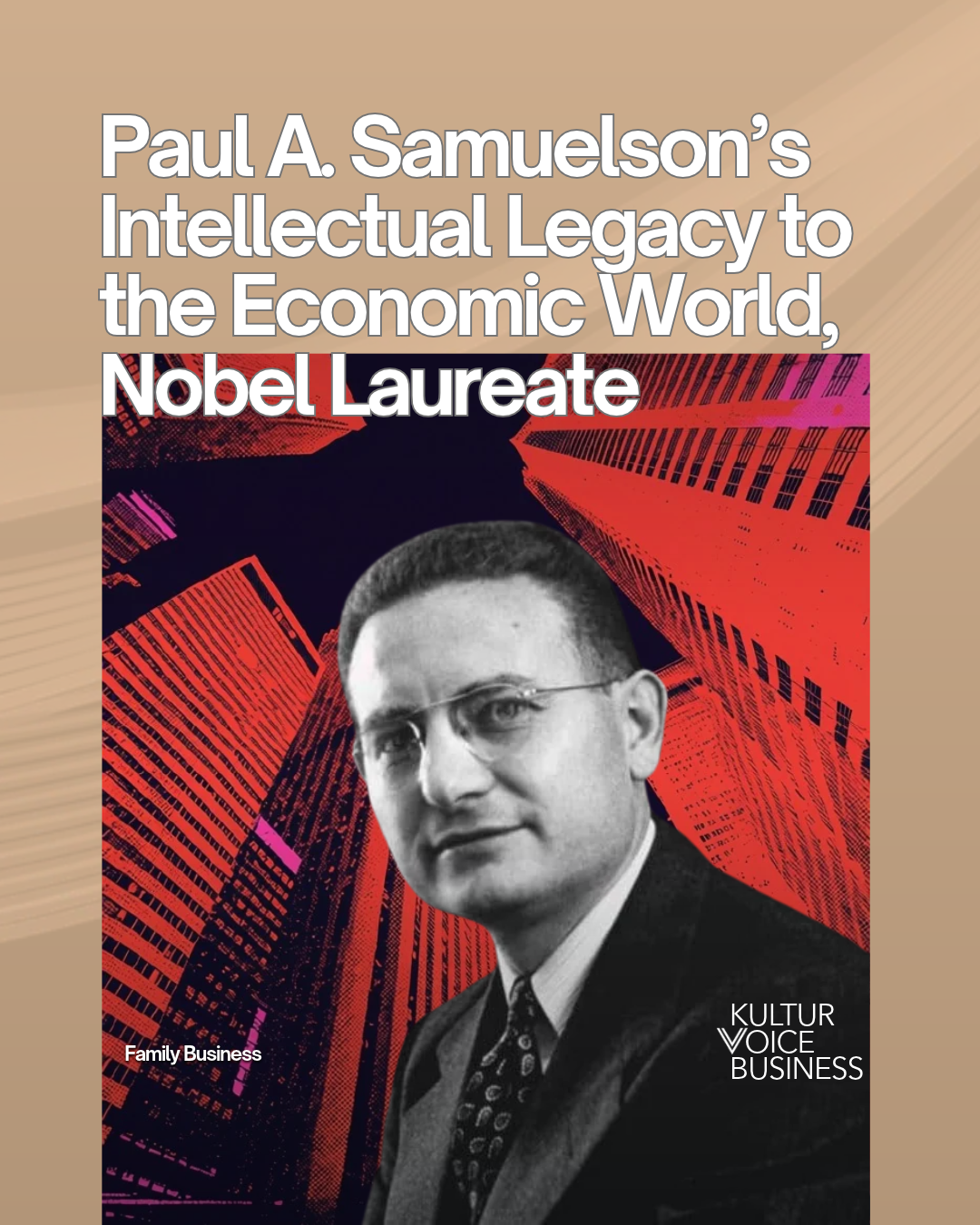

Paul Anthony Samuelson (1915–2009) was an influential American economist who played a major role in shaping modern economic thought. He was a professor at the Massachusetts Institute of Technology (MIT) and became the first American to receive the Nobel Memorial Prize in Economic Sciences in 1970. Throughout his career, Samuelson contributed to various branches of economics, including microeconomics, macroeconomics, international trade, and public finance. His work helped establish economics as a more systematic and mathematical discipline.
One of Samuelson’s greatest contributions was introducing mathematical methods into economic analysis. Through his influential book, Foundations of Economic Analysis (1947), he demonstrated how mathematical principles could be used to explain economic behavior, market equilibrium, and the relationship between supply and demand. This approach made economic theories more precise and easier to analyze.
He also developed the theory of revealed preference, which explains how economists can understand consumer preferences by observing their actual purchasing decisions rather than relying solely on what people say they prefer. This theory became an important foundation of modern consumer behavior analysis. Another significant contribution was his work on public goods, which are goods that people can share without necessarily reducing their availability to others, such as national defense and street lighting. His research helped explain why governments play an important role in providing these goods.
Additionally, Samuelson contributed to Keynesian economics, particularly through the development of the neoclassical synthesis. This approach combined Keynesian ideas about government intervention and economic stability with classical economic theories about markets and resource allocation. It helped explain how governments could use fiscal and monetary policies to manage unemployment, inflation, and economic fluctuations.
Samuelson’s influence extended beyond academic research. His textbook, Economics: An Introductory Analysis (1948), introduced generations of students to fundamental economic concepts and became one of the most widely used economics textbooks worldwide. His theories also influenced policymakers and governments in making decisions about taxation, public spending, international trade, and economic growth.
Paul A. Samuelson transformed the way economics was studied, taught, and applied. His contributions provided valuable tools for understanding markets, consumer decisions, and government policies. His legacy continues to influence economic education, research, and public policy today.
Latest news from Kultur Voice Business