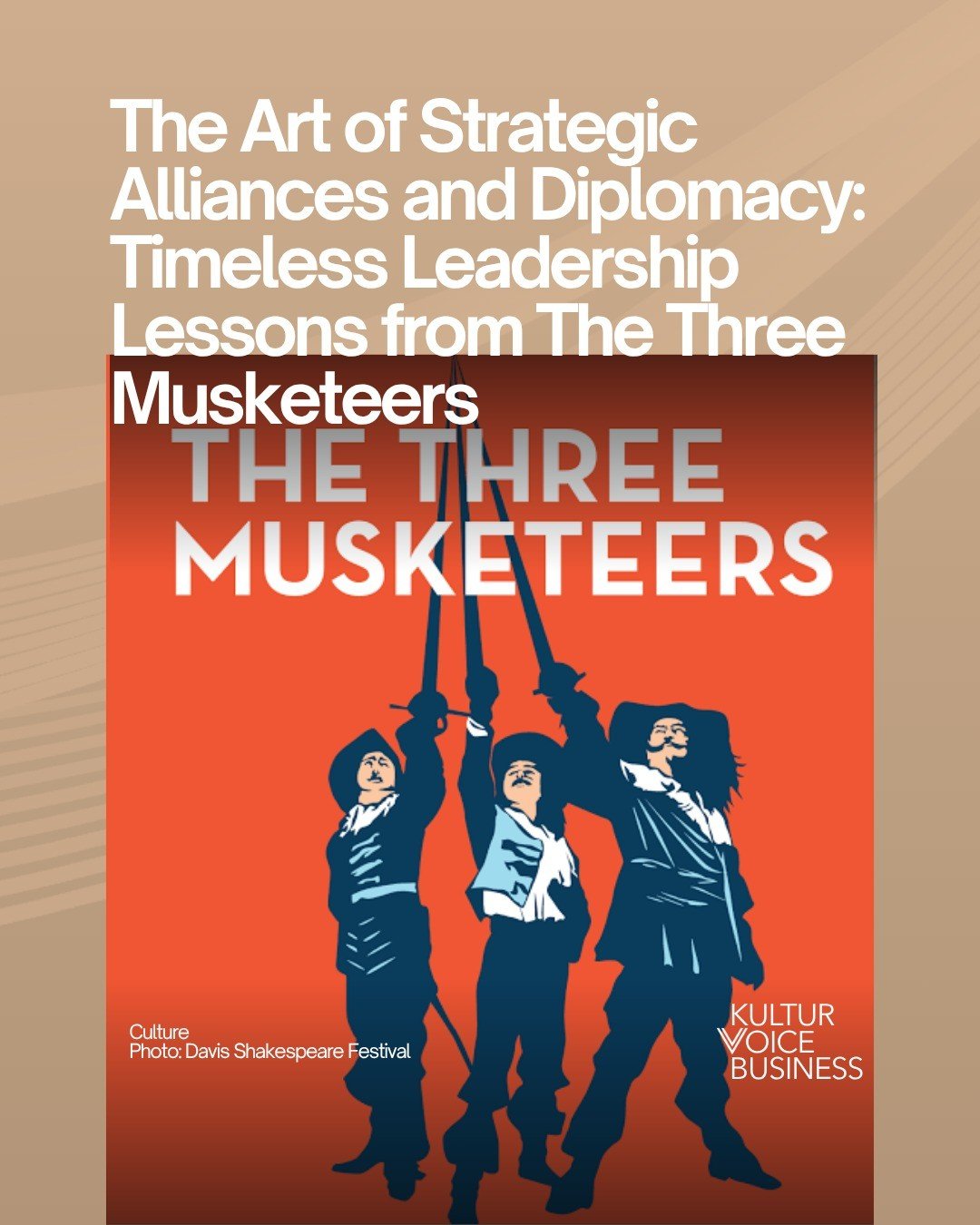

Alexandre Dumas’s canonical masterpiece, The Three Musketeers, has long been celebrated as a quintessential narrative of chivalry, adventure, and seventeenth-century intrigue. Yet, beneath its swashbuckling surface lies an enduring treatise on power dynamics, high-stakes diplomacy, and enterprise governance. For modern business leaders, family enterprise principals, and elite professionals, Dumas’s magnum opus provides a compelling case study on cultivating social capital, managing complex coalitions, and safeguarding intergenerational reputational equity.
The Architecture of Strategic Alliances and Shared Governance
At the very core of the narrative is the timeless maxim: “Tous pour un, un pour tous”—all for one, and one for all. Far from a mere romantic slogan, this principle serves as a masterclass in organizational synergy, partnership governance, and strategic alignment.
The alliance among d’Artagnan, Athos, Porthos, and Aramis succeeds because each individual brings a distinct, non-redundant set of competencies:
- Athos embodies stoic wisdom, noble pedigree, and seasoned crisis leadership.
- Porthos delivers sheer physical strength, tactical charisma, and expansive social presence.
- Aramis offers subtle diplomatic acumen, theological erudition, and strategic discretion..
- d’Artagnan acts as the catalyst, contributing raw ambition, agility, and unyielding drive.
In competitive corporate landscapes and family business governance, long-term resilience requires this precise level of complementary talent aggregation. A sustainable enterprise is rarely the product of solitary leadership; rather, it is built upon an unshakeable circle of trust where mutual loyalty, aligned incentives, and shared moral standards safeguard the collective enterprise from external disruption.
Mastering Social Capital and Diplomatic Acumen
In seventeenth-century Paris, survival and advancement were fundamentally dictated by relational intelligence, institutional etiquette, and the mastery of patronage networks. d’Artagnan’s ascent from an impoverished Gascon nobleman to a confidant of royalty underscores the power of high-register emotional intelligence and network cultivation.
The protagonists do not merely react to political shifts; they decode implicit motivations, manage reputational vulnerabilities, and maneuver within polarized environments with refined discretion. For high-net-worth individuals and corporate executives, this reflects the irreplaceable value of social capital. Cultivating high-trust networks, practicing strategic discretion, and maintaining impeccable professional conduct are far more potent instruments of influence than transactional authority or aggressive posturing.
Risk Management and Agility Under High-Stakes Pressure
The narrative arc of the Queen’s diamond studs exemplifies corporate risk management, agile execution, and contingency planning. Operating under severe resource constraints, hostile surveillance, and tight deadlines orchestrated by Cardinal Richelieu, the musketeers demonstrate tactical flexibility without compromising strategic intent.
Their operational doctrine offers several core takeaways for modern business strategy:
- Distributed Leadership: When members of the team are impeded, the remaining cohort continues the mission autonomously, illustrating the necessity of decentralized execution.
- Decisive Crisis Management: Critical decisions are made with rigorous calculation and rapid execution, mitigating the paralysis often caused by corporate ambiguity.
- Ethical Red Lines: Despite operating in a morally ambiguous theater of espionage, the musketeers adhere to a clear code of honor, protecting institutional legitimacy above short-term gains.
Building an Enduring Legacy Through Moral Integrity
For multi-generational family enterprises and boutique firms navigating modern market turbulence, The Three Musketeers serves as a profound reminder that enterprise durability is anchored in intangible assets: reputation, unwavering loyalty, and relational depth.
While market dominance and financial performance fluctuate with economic cycles, an organization’s core ethos and the strength of its strategic partnerships determine its ultimate longevity. By embedding fidelity, diplomatic grace, and collective accountability into corporate culture, forward-thinking executives can build an enduring legacy capable of withstanding the most intricate challenges of the global marketplace.
Alexandre Dumas (24 July 1802 – 5 December 1870), was a French novelist and playwright. His works have been translated into many languages and he is one of the most widely read French authors. Many of his historical novels of adventure were originally published as serials, including The Count of Monte Cristo, The Three Musketeers, Twenty Years After and The Vicomte of Bragelonne: Ten Years Later. He also wrote many plays and, since the early 20th century, many of his novels have been adapted into films. Prolific in several genres, Dumas began his career by writing plays, which were successfully produced from the first. He wrote numerous magazine articles and travel books; his published works totalled 100,000 pages. In the 1840s, Dumas founded the Théâtre Historique in Paris.
English playwright Watts Phillips, who knew Dumas in his later life, described him as “the most generous, large-hearted being in the world. He also was the most delightfully amusing and egotistical creature on the face of the earth. His tongue was like a windmill – once set in motion, you would never know when he would stop, especially if the theme was himself.
Latest news from Kultur Voice Business