
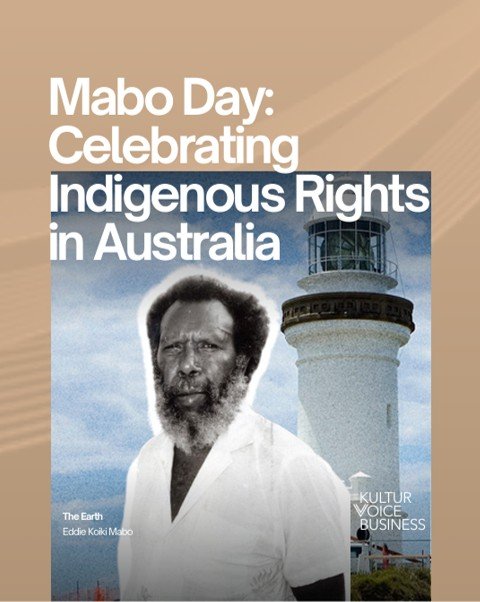

Have you heard about Mabo Day? It is a historical day, uniquely Australia.
Mabo Day is observed annually on June 3 in Australia to commemorate a landmark legal decision that transformed the nation’s understanding of Indigenous land rights. The day honors Eddie Koiki Mabo, a Torres Strait Islander man whose determination and courage led to one of the most significant court cases in Australian history.
Before the Mabo decision, Australian law was based on the concept of ‘terra nullius’, a Latin term meaning “land belonging to no one.” This doctrine assumed that Australia was unoccupied before British settlement in 1788, effectively denying the rights and ownership of Indigenous peoples who had lived on the continent for tens of thousands of years. As a result, Aboriginal and Torres Strait Islander communities were excluded from legal recognition of their traditional lands.
Eddie Mabo challenged this assumption by bringing a case before the High Court of Australia. Along with other plaintiffs, he argued that the Meriam people of the Murray Islands had long-standing ownership and connection to their ancestral land. After a legal battle that lasted more than a decade, the High Court delivered its historic judgment on June 3, 1992. The court rejected the doctrine of ‘terra nullius’ and recognized the existence of native title, acknowledging that Indigenous Australians had rights to their traditional lands that predated British colonization.
The Mabo decision marked a turning point in Australia’s legal and social history. It paved the way for the Native Title Act 1993, which established a framework for Indigenous communities to claim and protect their traditional land rights. More broadly, it encouraged Australians to confront historical injustices and foster greater recognition of Indigenous cultures and contributions.
Today, Mabo Day serves as a time for reflection, education, and celebration. Schools, community organizations, and cultural institutions often hold events to raise awareness about Indigenous history and the significance of native title. The day also highlights the ongoing journey toward reconciliation and equality between Indigenous and non-Indigenous Australians.
Mabo Day is much more than a commemoration of a court ruling. It represents the power of perseverance, the pursuit of justice, and the recognition of Indigenous peoples’ enduring connection to their land. By remembering Eddie Mabo’s legacy, Australians can continue working toward a more inclusive and equitable society.
Australia or Commonwealth of Australia is a country in the southern hemisphere consisting of the mainland of the Australian continent, the island of Tasmania, and various small islands in the Indian Ocean, and the Pacific Ocean. Australia comes from the word australis which in Latin means south. Legends about Terra Australis—”the foreign land of the South”—date back to Roman times, and were commonplace in medieval geography, although not based on any documented continental knowledge. The next European discovery, the names for the vast Australian mainland are often referred to as the famous Terra Australis.
About 40,000 years before European occupation in the late 18th century, Australia was inhabited by Aborigines, who began arriving from Southeast Asia during the last ice age. Arriving by sea, they settled on the continent and had formed about 250 different language groups by the time of European settlement, preserving some of the world’s longest-known artistic and religious traditions.
Australia’s written history begins with the exploration of European maritime in Australia. Dutch explorer Willem Janszoon was the first known European to reach Australia in 1606. However, in the late 18th century, Britain occupied the continent and made it a dumping ground for criminals. In the mid-19th century, gold mines were discovered in Australia, so that the continent was crowded with immigrants. Since then, they have fought for independence to self-govern Australia, regardless of British control. Until now, Australia is a member of the British Commonwealth.
In 1770, the British explorer, James Cook, mapped and claimed the east coast of Australia on behalf of Great Britain, and the First Fleet of British ships arrived in Sydney in 1788 to establish the New South Wales prison colony, which was officially established on 7 February 1788 (although formal ownership was only declared on 26 January 1788). The population of European descent increased in the following decades, and by the end of the gold rush in the 1850s, much of the Australian continent had been explored by European settlers and five self-governing British colonies were established.
Australia is neighboring Indonesia, Timor Leste, and Papua New Guinea to the north; the Solomon Islands, Vanuatu, and New Caledonia to the northeast; and New Zealand in the southeast. Australia is the largest country in Oceania and the sixth largest in the world. Australia is the oldest, flattest, driest and most inhabited continent with the least fertile soil. Australia is home to a wide variety of landscapes and climates, with deserts in the outback, tropical rainforests in the northeast, and mountains in the southeast.
Australia’s abundant natural resources and well-established international trade relations are essential to the country’s economy, generating income from a wide range of sources including services, mining exports, banking, manufacturing, agriculture and international education.
Australia ranks among the highest in the world in terms of quality of life, democracy, health, education, economic freedom, civil liberties, security and political rights, with all major cities achieving outstanding levels in global comparative livability surveys.
 Australia’s population of nearly 26 million is highly urbanized and highly concentrated on the east coast. Canberra is the country’s capital, while its most populous city and financial hub is Sydney. The next four largest cities are Melbourne, Brisbane, Perth, and Adelaide. Australia’s demographics have been shaped by immigration for centuries: the number of immigrants is about 30% of the country’s population, and almost half of Australians have at least one foreign-born parent.
Australia has often been referred to as Oz in conversation since the early 20th century. Aussie is a conversational term for Australian people.
If this perspective sparked a new idea for how you lead, build, or live, explore more stories on Kultur Voice Business or KVB.global — where global perspectives meet local living.
Latest news from Kultur Voice Business

zimerovertover 13 Aug 2026
very good post, i certainly love this website, keep on it