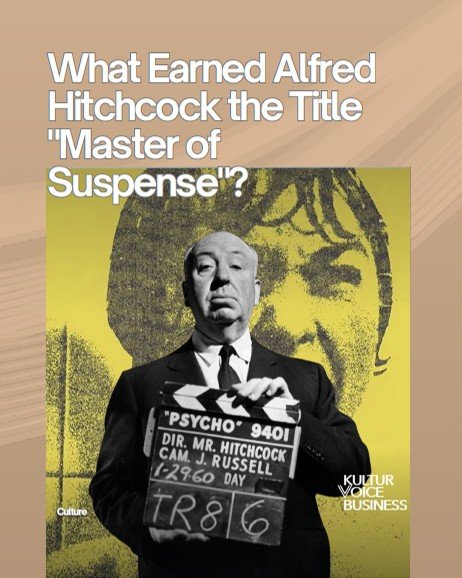

Alfred Hitchcock is remembered as one of cinema’s greatest directors, but his story also offers valuable lessons for entrepreneurs and family businesses. Alfred Hitchcock had strong influence that can be seen across generations of filmmakers, particularly in the thriller, mystery, horror, and psychological drama genres, while his techniques have inspired directors such as Steven Spielberg, Martin Scorsese, Brian De Palma, and many others.
Behind the title “Master of Suspense” was a professional who understood the importance of mastering his industry, building a distinctive identity, taking calculated risks, and creating a legacy that could outlast him.
Hitchcock’s other notable films include Rope (1948), Strangers on a Train (1951), Dial M for Murder (1954), To Catch a Thief (1955), The Trouble with Harry (1955), Vertigo (1958), North by Northwest (1959), The Birds (1963), Marnie (1964) and Frenzy (1972), all of which were also financially successful and are highly regarded by film historians. Hitchcock made several films with some of the biggest stars in Hollywood, including four with Cary Grant, four with James Stewart, three with Ingrid Bergman and three consecutively with Grace Kelly.
Born in London in 1899, Hitchcock did not begin his career as a celebrated director. He started in the British film industry during the silent era, taking on various behind-the-scenes roles, from designing title cards to working in art direction and production. These early experiences gave him a broad understanding of how the industry operated. Before becoming a leader, Hitchcock learned the business from the inside. His past experiences proved that strong leadership is often built on a deep understanding of the processes, people, and challenges behind a business.
In a highly competitive industry, Hitchcock also understood the power of differentiation. He developed a filmmaking style that became instantly recognizable: suspense. His strength was not simply creating unexpected surprises, but carefully controlling what audiences knew and when they knew it. Through camera work, editing, sound, and storytelling, Hitchcock created a consistent experience that set him apart. Over time, his name itself became associated with a particular standard of filmmaking, demonstrating how a clear and consistent identity can become one of a business’s strongest competitive advantages.
His approach to innovation was equally strategic. Hitchcock was known for meticulously planning his films before production began, allowing him to execute ambitious ideas with greater precision. Yet preparation did not make him resistant to risk. Films such as Rope and Psycho challenged established conventions through bold visual techniques and unconventional storytelling choices.
Hitchcock also understood that creating a successful product was only part of the equation. He became a recognizable public figure and helped turn anticipation and audience curiosity into part of the experience surrounding his films.
More than four decades after his death, Alfred Hitchcock’s legacy continues to shape cinema. He showed Hollywood that a director’s greatest tool was not simply the story being told, but the control of what the audience sees, knows, fears, and expects next. Hitchcock became an American citizen in 1955.
Culture shapes how we live, create, and do business. Kultur Voice Business explores the ideas, traditions, craftsmanship, and communities that inspire everyday living and entrepreneurship. Need support in content production or public relations? Contact KVB at hello@kvb.global.
Latest news from Kultur Voice Business