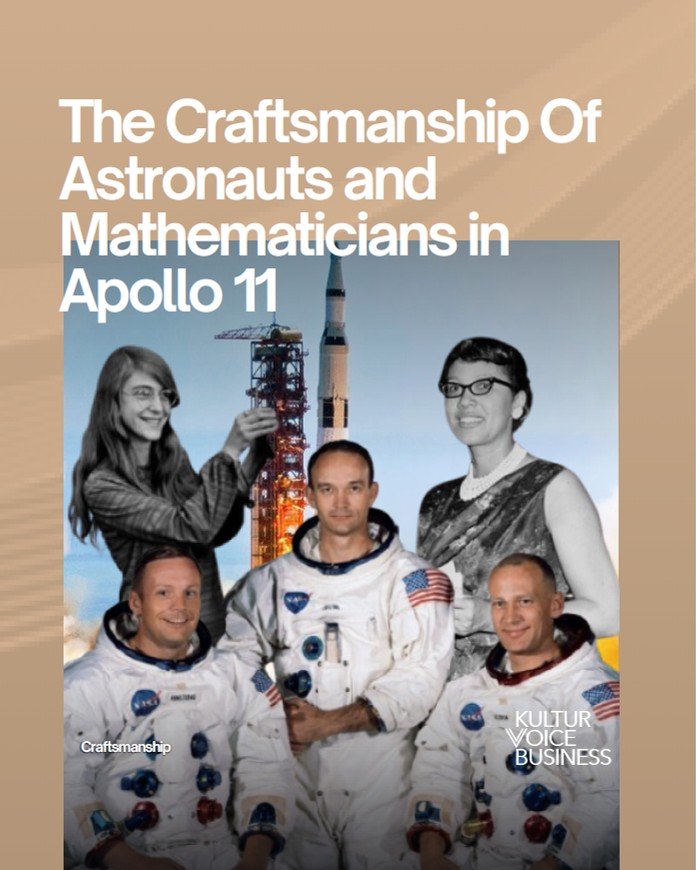

The launch of Apollo 11 on 16 July 1969 is often celebrated as a triumph of industrial might and political will while at its core the journey of humanity to the Moon was a masterpiece of supreme craftsmanship. The launch of Apollo in 1969 was an exquisite alignment of deep human skill, meticulous knowledge, and manual precision. While the towering Saturn V rocket represented the physical vessel of this grand voyage, the true engine of the mission was the specialized artistry of the individuals who guided it, both inside the roaring cockpit and behind the quiet calculation sheets on Earth.
For the astronauts, Neil Armstrong, Buzz Aldrin, and Michael Collins, craftsmanship was defined by an unprecedented synthesis of piloting instinct and scientific expertise. They were not merely passengers; they were master technicians of the cosmos. Armstrong and Aldrin had to master the intricate, non-linear physics of the Lunar Module, translating abstract orbital mechanics into split-second physical maneuvers. When the automated guidance system steered the lander toward a hazardous, boulder-strewn crater, it was Armstrong’s manual artistry, honed through thousands of hours of intense training in simulators—that allowed him to semi-manually guide the spacecraft Eagle onto the lunar dust with only seconds of fuel remaining.
This physical craftsmanship, however, was entirely dependent on a different kind of artisan: the mathematical weavers on the ground. Long before the rocket ignited, mathematicians like Katherine Johnson, Margaret Hamilton, and the team of human “computers” (NASA’s mathematician team) crafted the invisible pathways through space. If the astronauts were the sculptors of the flight, the mathematicians were the architects of the stone. Hamilton’s pioneering software craftsmanship involved hand-writing thousands of lines of code, designing a system that prioritized critical tasks to prevent overloads during the stressful landing sequence. Katherine Johnson’s calculations of trajectories represented a pinnacle of mathematical craftsmanship, where a single misplaced decimal point would mean losing three souls to the vacuum of space.
As we remember the day that falls 57 years ago today for the launch of Apollo 11, we remember to redefine the boundaries of human capability by merging physical and intellectual artistry. The historic mission succeeded because the absolute precision of the mathematician’s pencil met the flawless mastery of the astronaut’s hand, demonstrating that exploration is the ultimate craft.
In appreciating the craftsmanship, let’s get to know of all the artisans.
Katherine Johnson (26 August 1918 – 24 February 2020) was a mathematician and human computer whose calculations or orbital mechanics at NASA, earning reputation for mastering complex manual calculations and helped pioneer the use of computers to perform tasks previously requiring humans. The space agency noted her “historical role as one of the first African American women to work as a NASA scientist”. Katherine Johnson’s calculations were also essential to the beginning of the Space Shuttle program, and she worked on plans for a human mission to Mars. President Barack Obama awarded Katherine Johnson with the Presidential Medal of Freedom in 2015 besides other recognitions and in 2021, she was posthumously inducted into the National Women’s Hall of Fame.
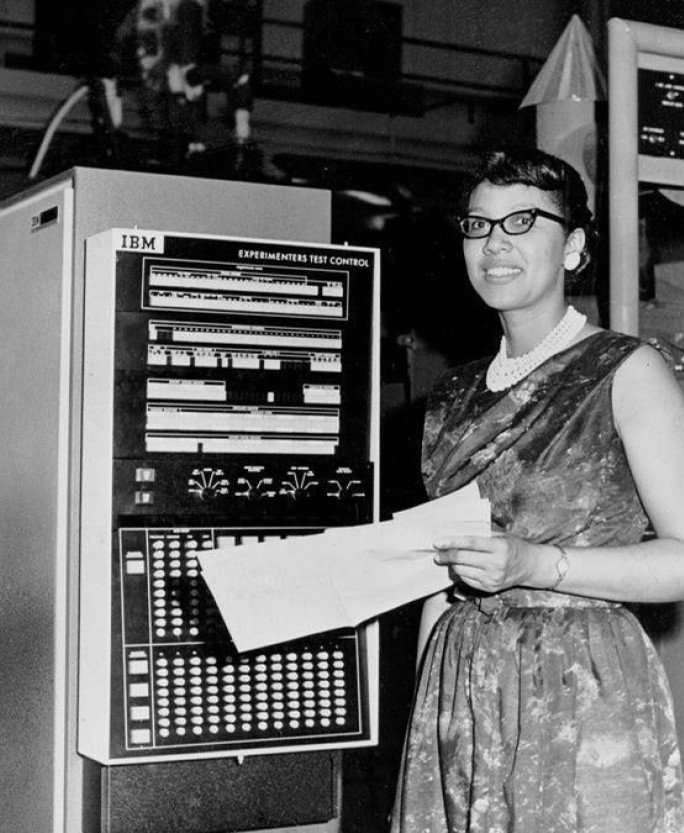 Margaret Hamilton, born on 17 August 1936, is an American computer scientist. She directed the Software Engineering Division at the MIT Instrumentation Laboratory, where she led the development of the on-board flight software for NASA’s Apollo Guidance Computer for the Apollo program. She later founded two software companies, Higher Order Software in 1976 and Hamilton Technologies in 1986, both in Cambridge, Massachusetts. Margaret Hamilton has published more than 130 papers, proceedings, and reports, about sixty projects, and six major programs. She coined the term “software engineering”, stating, “I began to use the term ‘software engineering’ to distinguish it from hardware and other kinds of engineering, yet treat each type of engineering as part of the overall systems engineering process. Margaret Hamilton received the Presidential Medal of Freedom from President Barack Obama on 22 November 2016 for her work leading to the development of on-board flight software for NASA’s Apollo Moon mission.
Buzz Aldrin or Edwin Eugene Aldrin Jr. (born on 20 January 1930 in New Jersey) is an American engineer, former astronaut, and fighter pilot. He served as a lunar module pilot on the Apollo 11 mission. He was the second person to land on the Moon after mission commander Neil Armstrong. He graduated from the United States Military Academy, West Point, in 1951 and entered the United States Air Force and served as a fighter pilot during the Korean War. After graduating from the Massachusetts Institute of Technology’s astronautics major, he was selected as a member of NASA Astronaut Group 3 and became the first astronaut to earn a Ph.D. degree. After leaving NASA in 1971, he served as the Commander of the United States Air Force Experimental Pilot School. He retired from the Air Force in 1972 after 21 years of service. He is still actively voicing the importance of space exploration, especially manned missions to Mars.
Celebrating culture. Elevating craftsmanship. Follow Kultur Voice Business for stories on culture, heritage, creativity, and the people shaping communities around the world.
Latest news from Kultur Voice Business