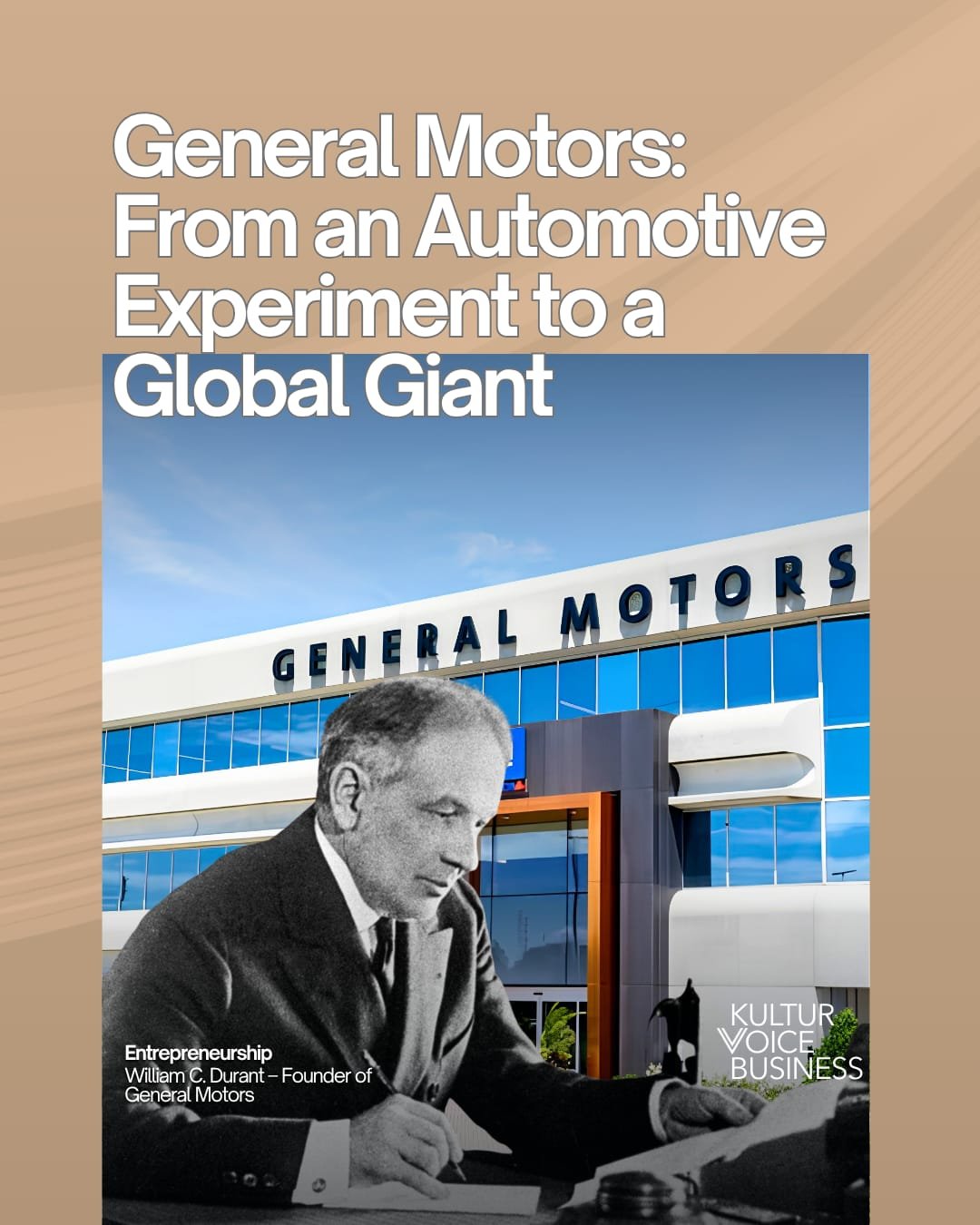

General Motors (GM) is one of the most influential automakers in automotive history. William “Billy” Durant founded General Motors on September 16, 1908, in Flint, Michigan, with a business model that was unconventional for the era. Rather than build the company around a single marque, Durant sought to unite multiple automobile manufacturers under one corporation, creating economies of scale, a broader product range, and stronger market reach. Buick and Oldsmobile formed the foundation of the new enterprise and launched GM’s century-long evolution into a global automotive company.
William Durant and GM’s Early Expansion
Durant rapidly expanded General Motors through an aggressive acquisition strategy. Within just 16 months, GM had acquired 22 businesses, including Cadillac, Oakland, and GMC. The strategy gave General Motors a diversified portfolio spanning passenger cars, premium automobiles, and commercial vehicles, enabling the company to reach customers across multiple price points and market segments. Durant even attempted to acquire Ford in 1909, but the deal did not succeed. Although the pace of expansion created financial and managerial pressures, it established the multi-brand model that would define GM for decades.
Alfred P. Sloan and GM’s Management Structure
General Motors’ corporate management later evolved under Alfred P. Sloan, who transformed a loose collection of businesses into a more disciplined organization. Sloan introduced a decentralise management system in which individual automotive divisions retained substantial operating independence while financial planning, policy, and long-term strategy were coordinated centrally. This balance of divisional accountability and corporate oversight became an influential model for modern business management. Sloan’s philosophy was closely associated with offering “a car for every purse and purpose,” positioning GM brands at distinct price levels so the company could serve buyers as their needs and purchasing power changed.
General Motors Brands and Market Positioning
Over the decades, GM became associated with some of the best-known names in the American automotive industry. Today, the company’s core vehicle portfolio consists of Chevrolet, Buick, GMC, and Cadillac, with each brand targeting different customer expectations. Chevrolet offers a broad range of mainstream cars, trucks, SUV, and electric vehicles; GMC emphasizes trucks, SUV, capability, and premium utility; Buick occupies an attainable premium position; and Cadillac represents GM’s luxury and technology flagship. This brand architecture helps General Motors compete across mass-market, premium, commercial, performance, and luxury vehicle segments without relying on a single identity.
Financial Challenges, Bankruptcy, and Recovery
General Motors’ history has also included major economic and organisational challenges. The company faced financial pressure during the Great Depression and, decades later, entered Chapter 11 bankruptcy restructuring during the 2008–2009 financial crisis. The reorganisation reduced complexity and allowed a new General Motors Company to emerge in 2009 with renewed emphasis on efficiency, product quality, and long-term competitiveness. The recovery became another important chapter in GM’s history, demonstrating both the risks of scale and the company’s capacity to restructure its operations and brand portfolio.
GM’s Electric Vehicle and Software Strategy
Today, GM is moving beyond traditional automobile manufacturing. Alongside gasoline-powered vehicles, General Motors is investing in electric vehicles, battery technology, connected-car software, and advanced driver-assistance systems. This transition reflects a wider shift in the auto industry, where vehicle platforms increasingly combine mechanical engineering with batteries, digital services, data, and recurring software features. OnStar illustrates GM’s long-standing role in connected safety and security services, while Super Cruise highlights its development of hands-free driver-assistance technology for compatible roads and vehicles. Together, these platforms show how software, connectivity, and subscriptions are becoming more important to GM’s customer experience and business model.
Why General Motors Remains Important
From Durant’s ambitious acquisitions and Sloan’s management innovations to bankruptcy recovery and today’s transition toward electric mobility and automotive software, the history of General Motors is a story of continual reinvention. GM’s enduring influence comes from more than its size: the company helped shape multi-brand automotive strategy, modern corporate organization, mass-market vehicle positioning, and connected driving technology. Its ability to adapt while maintaining Chevrolet, Buick, GMC, and Cadillac as recognisable automotive brands remain central to its relevance in a rapidly changing global industry.
Explore Kultur Voice Business for content on family business, entrepreneurship, lifestyle, culture, Southeast Asia at htps://kvb.global .
Latest news from Kultur Voice Business